
50 machines to restart civilization. From a pottery and brick kiln to a relay computer.
Video paused to reduce motion. Press play to watch.
Why this book
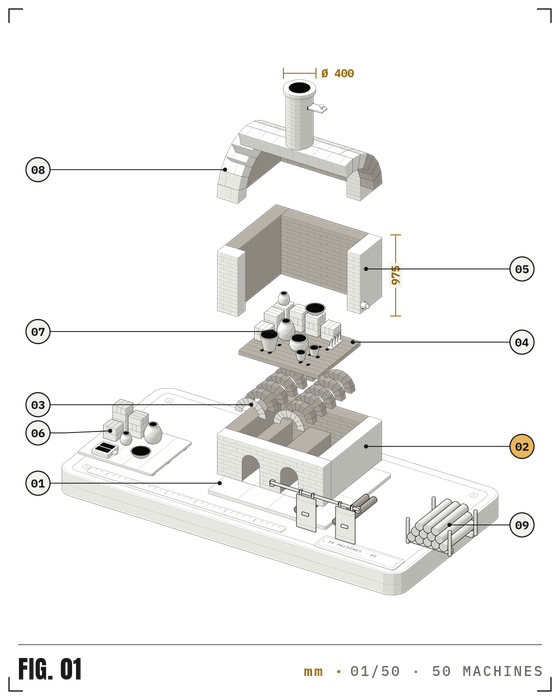
50 Machines is a field manual. It shows 50 machines in the order you could build them. Each machine uses only what the machines before it make. The list starts with a pottery and brick kiln and ends with a relay computer.
Technology moves forward and helps people live better, but people also depend on it more every year. So it is worth understanding what starting over would mean. My son Mateo asks why and how everything works, and takes it apart to understand it. That is why I made 50 Machines. I think of Stealing Fire, by Steven Kotler and Jamie Wheal, and of Prometheus, who gave fire and knowledge to humankind.
The order is my judgment. The main sources are Lewis Dartnell’s The Knowledge, Open Source Ecology’s Global Village Construction Set, Practical Action’s technical briefs, David Gingery’s books, and Hugh Piggott’s wind turbine plans. Each machine gets a score for lives saved, later machines that depend on it, labor saved, how easy it is to build, and how easy it is to keep running.
The tree starts with what keeps people alive: fire and clean water. The aim is to live well, not just long.
Each guide lists the parts, the steps, and a check for each step. These are the first 50 machines. The site stays as a record, and others can keep building on it.
Rolando Zubirán, PhD
For Mateo, and every kid who asks why
Mateo is five. He asks why and how everything works, and when the answer isn't enough, he takes the thing apart to find out. I made this book for him.
That habit is the best thing we have as people. Every machine in these pages started with someone who wanted to know how something worked and wouldn't stop until they did. Fire, the wheel, the pump, the loom. Each one was a question somebody kept asking.
I think a lot about Prometheus, who gave fire and knowledge to people, and about Stealing Fire, by Steven Kotler and Jamie Wheal. Knowledge has always been guarded by a few. That is changing. Superintelligence is going to put it in everyone's hands, and what we do with it will depend on whether we stay curious.
I also want Mateo to know that living well means having fun. That's why the book has one more machine after the fifty. Machine 51 doesn't help anyone survive. It's a marble run for a parent and a child to build together, turn the crank and count the bells. I dedicated it to him.
So Mateo, keep asking. Keep taking things apart. Grow, and play while you grow. The world belongs to the curious ones.
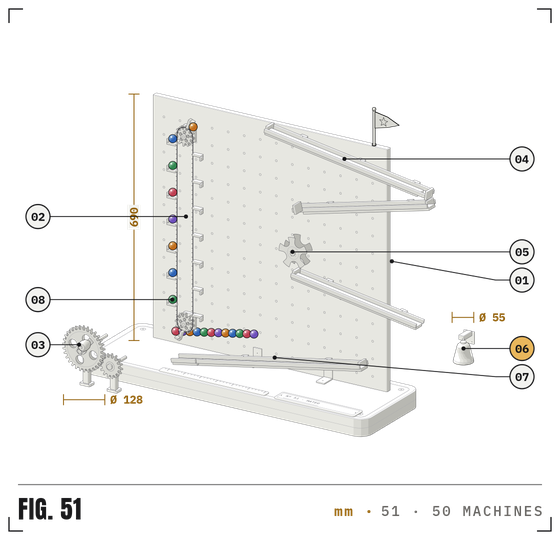
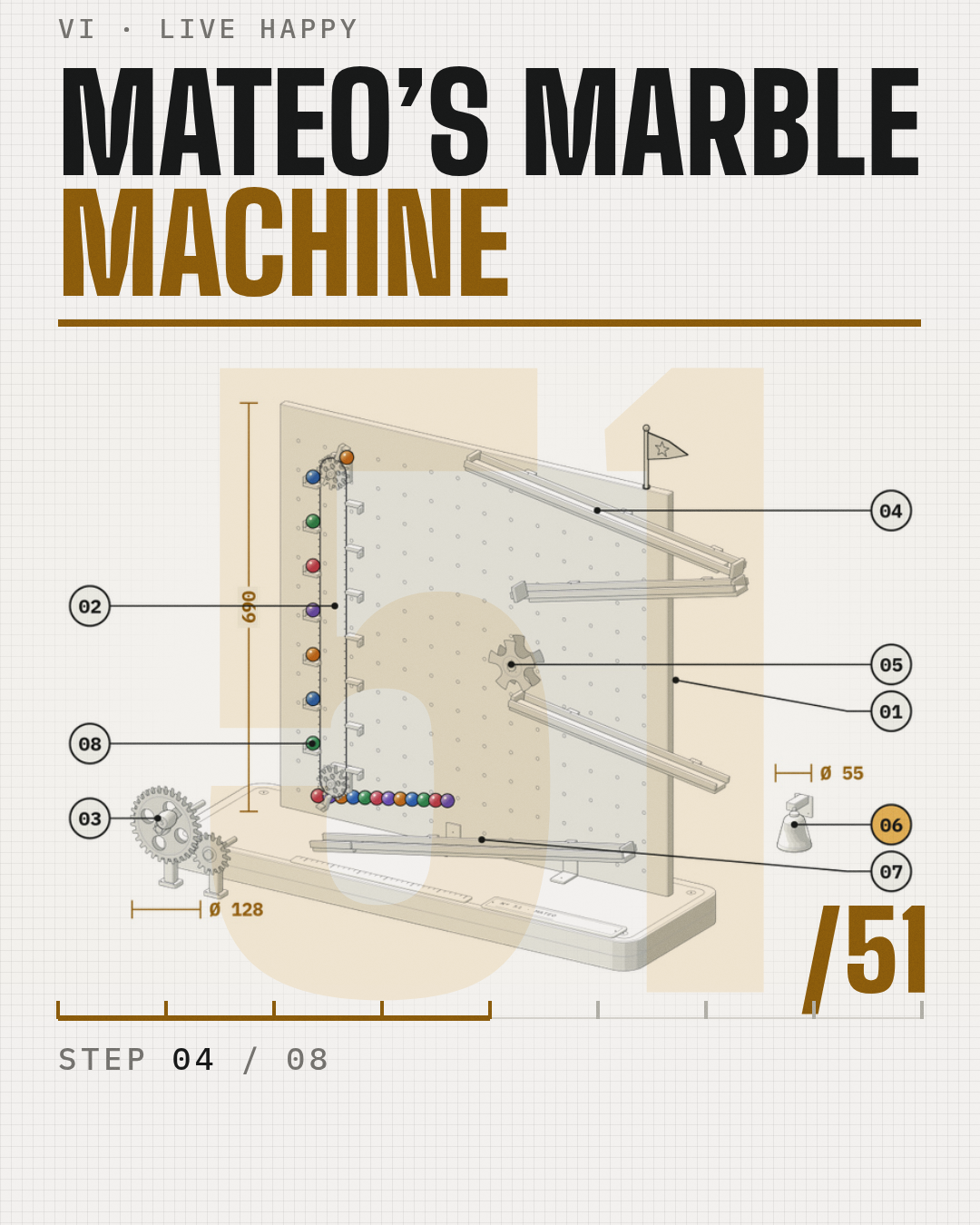
Turn the crank: cups lift the marbles, they zigzag down, turn a wheel and ring a bell, again and again.
The 50 machines, and one more. This one is not for surviving. It is a toy for a parent and a child to build and play with together, and it is made from what earlier machines make: clay marbles from the kiln, glass marbles from the glass furnace, the climbing loop of the rope pump, a bell from the foundry, wooden parts from the pole lathe, and gears and a crank.
How it works. Turn the crank and a chain of small wooden cups lifts the marbles up one side of an upright pegboard. Each turn lifts 4 marbles 53.3 cm. At 30 turns a minute the chain moves at 15.2 cm/s, so a marble climbs in about 3.5 s. Off the top ramp it rolls at v = √(2·g·h·5/7). The marbles zigzag down, turn a wheel with five pockets, ring a bronze bell 5.5 cm across and run back along the bottom to wait for a cup. With 20 marbles, a full loop takes at least 10 s at that speed. These figures come from an ideal model that ignores friction, so real marbles run a little slower.
Mateo’s job. Every step has a task for a child: sort the marbles by colour, count the wheel’s pockets, turn the crank and count the bells.
Safety. Marbles are a choking hazard for children under 3 years: play with an adult present and keep them away from younger children. Adults do all the sawing, drilling, turning and casting.
The tech tree
Tap any machine to trace it. Brass lines run back to everything it needs; the dark ones run forward to everything it unlocks.
Swipe →
The 50
Survival comes first because everything else stands on it: clean water, fire, soap, metal. After that the list turns toward living well: power, cold, light, and machines that think.
Guides
Each guide is an exploded build. Parts drop in step by step with what you need, what to do and how to check it, then the machine runs on real numbers.
Method
The order is my judgment, built from published survival and appropriate-technology work. The numbers on each card come from those sources.
Scored, then sorted by need
Each machine is scored on lives saved, how many later machines it unlocks, labour saved, how buildable it is and how easily it is kept running. Anything a machine needs is moved ahead of it.
Salvage first, scratch as fallback
For years after a collapse a car alternator, a solar panel or a radio is easier to find than to make. Guides start from salvage where it is realistic and keep the from-scratch route beside it.
Drawn from real sources
Lewis Dartnell's The Knowledge, Open Source Ecology's 50-machine Global Village Construction Set, Practical Action's technical briefs, David Gingery's shop-from-scrap series and Hugh Piggott's wind turbine plans.
The book
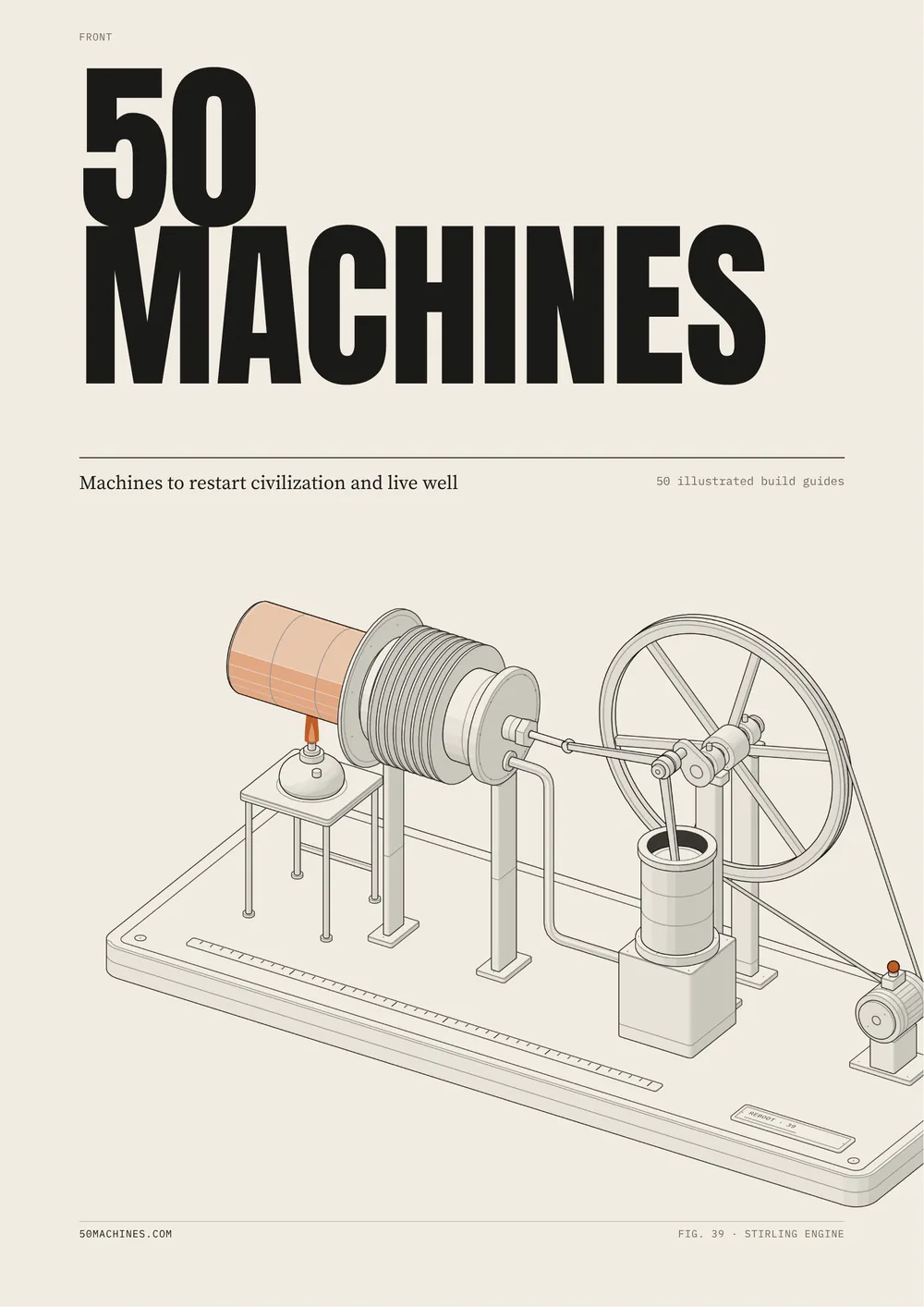
The website needs power and a screen. A book needs neither. That is why 50 Machines is also a printed manual.
What is inside
The same 50 machines as the site, in the same order and the same five parts. Each machine has its isometric drawing, its list of parts and the essential steps. A sidebar gives the difficulty, the machines it builds on, the key numbers, the dimensions and the safety notes. The website keeps the complete steps and a check for each one.
Made for the workbench
336 pages. The paperback is 80# coated paper: standard, or premium with richer color and deeper blacks. The cloth edition is a limited edition of 500 unnumbered copies, only sold at 50machines.com. A spread opens wide enough for the drawings, and the book is made to sit open on a bench. Each copy is printed on demand when it is ordered.
Why paper
I want the knowledge in this project to last and to move from one person to the next. Paper does that well. You can lend it, mark it and keep it for years. It works when nothing else does. English and Spanish editions, shipped from Spain.
Order direct at 50machines.com. Delivery takes approx. 2 weeks and no later than 30 calendar days from the order. Shipping is calculated at checkout. The book is published through Lulu. Lulu prints each copy on demand and ships it. © 2026 Rolando Zubirán. Exploitation rights assigned exclusively to ASSEMBLR VENTURES, S.L.
You have 14 days to withdraw after delivery. The economic operator responsible for the book in the EU is ASSEMBLR VENTURES, S.L., Calle Príncipe de Vergara 13, 4th floor, door E, 28001 Madrid, Spain, direccion@quantumhive.es. Paperback ISBN 978-1-291-48311-6. Read the safety notice before you build anything.
Delivery takes approx. 2 weeks and no later than 30 calendar days from the order. Shipping is calculated at checkout.
Contribute a machine
The tree is open. Anyone can add a guide.
An open tree
50 Machines is an open source technology tree. I made the first 50 machines. I want the tree to keep growing, one guide at a time, built by the people who use it.
The same format
A new guide must match the format of the existing ones. It needs an isometric model, a list of parts, numbered build steps with a check for each step, and the machine running on real numbers. It must also state which earlier machines it needs.
Your own AI, your own checks
You do not need to draw it all by hand. You can use your own AI, together with the templates and the prompt kit. Check every number and every step yourself before you send it. Every guide is reviewed before it joins the tree, marked as community.
- 1 Propose the machine in an issue
- 2 Copy the template, draft, check
- 3 Open a pull request with the checklist
- 4 Review for format, truth and safety
- 5 Published in the tree as community
Support the project
Help the tree grow.
I keep 50 Machines free to read: the 50 machines, the tree and the guides. If it is useful to you, you can help me keep it going.
The ebook, €9.99
The whole book in EPUB, in English or Spanish. Download after purchase.
Buy the ebook · €9.99, buy in the store (opens in a new tab)Machine of the Month, €2 a month
Each month, one machine plate is emailed at print resolution. First the 50 from the book 50 Machines, then new machines. When a machine's illustrated guide is published, the link is included too. In English or Spanish.
The illustrated guides are published on 50machines.com. What arrives each month is the plate, ready to print.
€2 a month, VAT included for EU customers. It is digital: nothing is shipped. Cancel whenever you want.
Machine of the Month · €2 a month, buy in the store (opens in a new tab)Other ways to help today: contribute a machine or share the site.