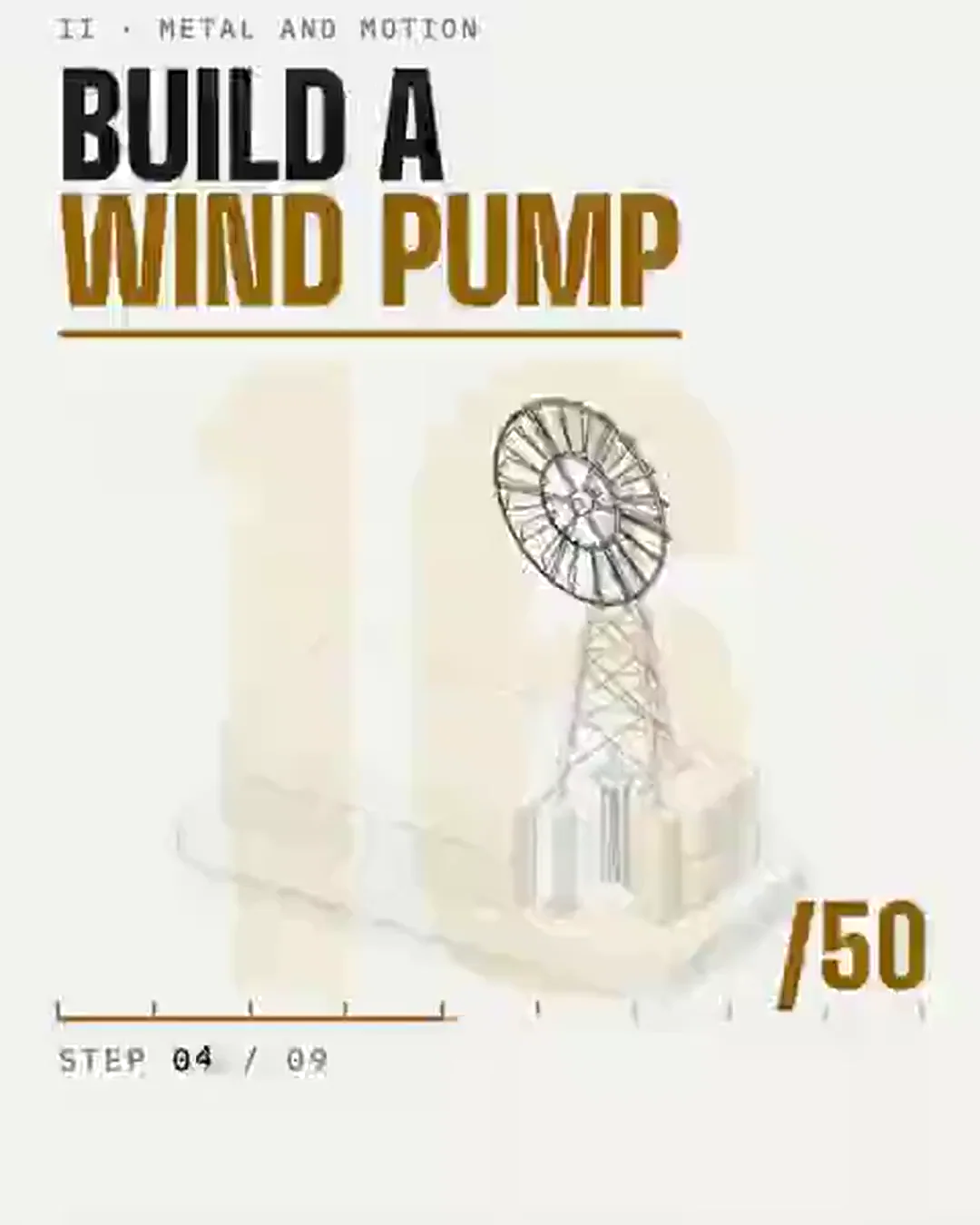
Machine 16Build a wind pump← → step through the guideborehole · Ø 31 cm casing
Wind0 m/s
Wheel0 rpm
Pump0 /min
Water0 L/h
Per day0 m³
Lift0 kWh/d
What this step adds; in part B, water on the moveParts already in placeA 2.4 m wheel of 18 steel sails sweeps 4.5 m². Unlike the fast three-blade turbine of machine 25, which spins an alternator, this wide, slow wheel gives strong torque at low speed and works a piston pump through a 3 : 1 back gear and a crank: no electricity anywhere. The model assumes the wheel takes at most 30% of the wind's power (½ × air density × area × speed³) when its tips move as fast as the wind, a 12 cm bore and 20 cm stroke (2.26 L a stroke, 90% delivered), 70% mechanical efficiency and a 10 m lift: water 7 m down in the borehole, drawn much shorter, to a tank inlet 3 m up. Balancing the wheel's power against the pump's load, it starts at about 2.9 m/s; at 5 m/s it turns 53 rpm and makes 18 strokes a minute, 2,148 L/h, or 52 m³ if that wind blew all day. Practical Action's sizing relation, kWh/day = 0.002725 × m³/day × head (m), gives the energy that water carries: 1.40 kWh/day. The wheel and rod are drawn at 1/3 speed and the tank fills 120× faster than real. This is a guide to how the parts go together, not engineering drawings. Never climb the tower or work on the head with the wheel free to turn: furl it out of the wind and tie it first, and keep children off the tower. Cap the borehole so nothing can fall or wash into it.