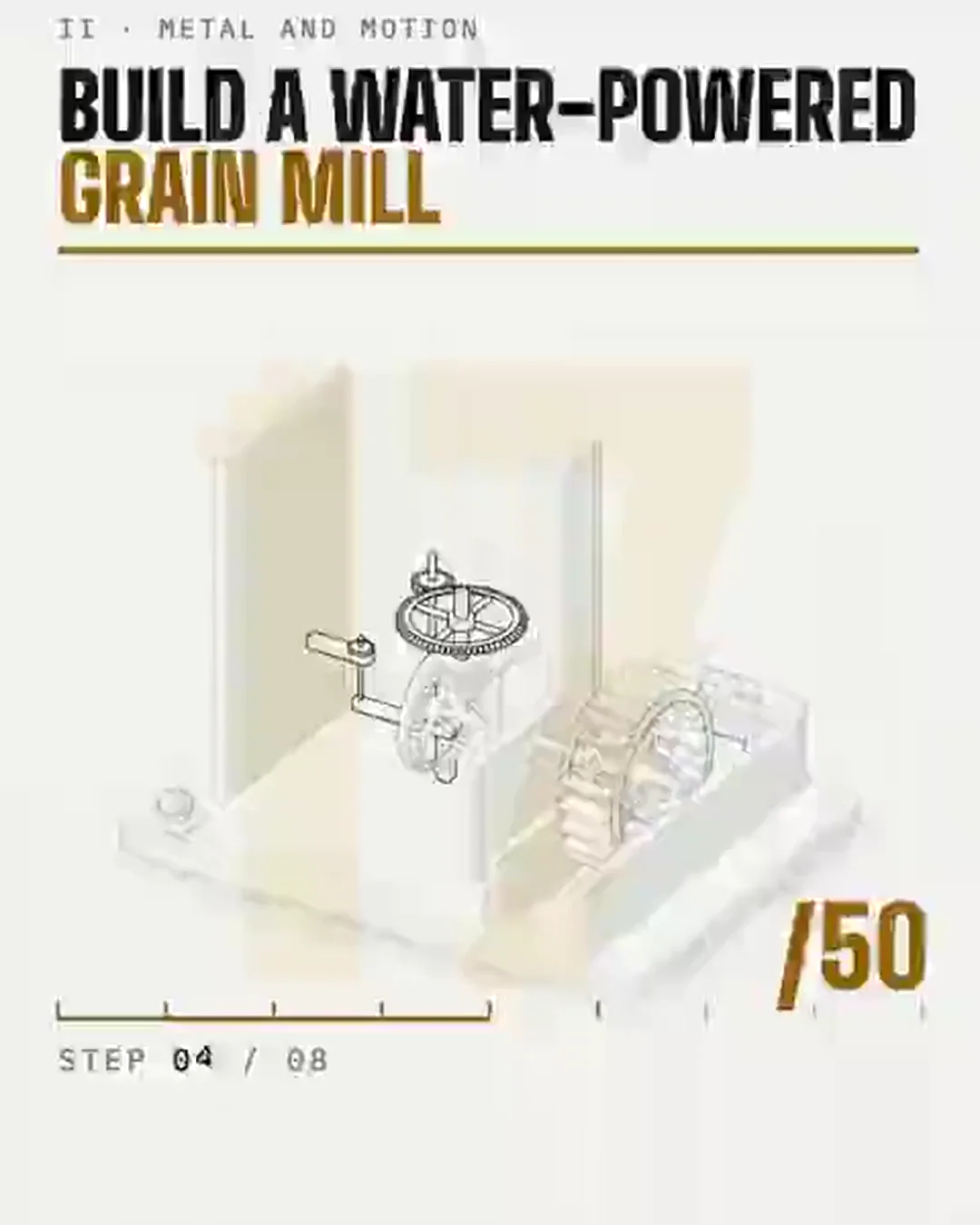
Machine 17Build a water-powered grain mill← → step through the guiderace · 1.2 m wide · gate shut
Water0 L/s
Wheel0 rpm
Runner0 rpm
Flour0 kg/h
Hand querns0
Sack ×3000 kg
What this step adds; in part B, the grain and the flourParts already in placeAn undershot wheel 2.8 m across, driven by water released under a sluice from 1 m higher. The water leaves the gate at √(2 × 9.81 × 1) = 4.4 m/s, and an impulse wheel does best with its floats at half that, 15.1 rpm at full flow; the model takes the grinding load as a steady torque, so the wheel's speed follows the flow. Gears by tooth count: pit wheel 48 cogs to wallower 16 staves (3 : 1), great spur wheel 60 to stone nut 18 (3.33 : 1), so the runner turns 10 times as fast as the wheel, 151 rpm at full flow. Water power is 9.81 × flow × head; the wheel keeps about 55% (undershot wheels ran 50–60% after the 18th century) and the gears an assumed 90% of that, 2.9 kW at the stones from 600 L/s. For flour the model assumes the stones need what a person spends at a hand or pedal mill, about 75 W for 2.5 kg/h (the mill grinds 2–3 kg/h), or 30 Wh per kg: 97 kg/h fully open, the work of about 39 people at querns, and in a 12-hour day a day's flour (2.5 kg) for about 470 families. England had 5,624 watermills in 1086, most with one pair of stones like this. The sack on the page fills 300 times faster than real time. This is a guide to how the parts go together, not engineering drawings: have a millwright check the race, the shafts and the gearing before you build. Keep hands, hair and loose clothes clear of the gears and shut the sluice before you reach into the wheel or the gear floor; flour dust in the air can explode near a flame, so keep lamps closed and the floors swept.