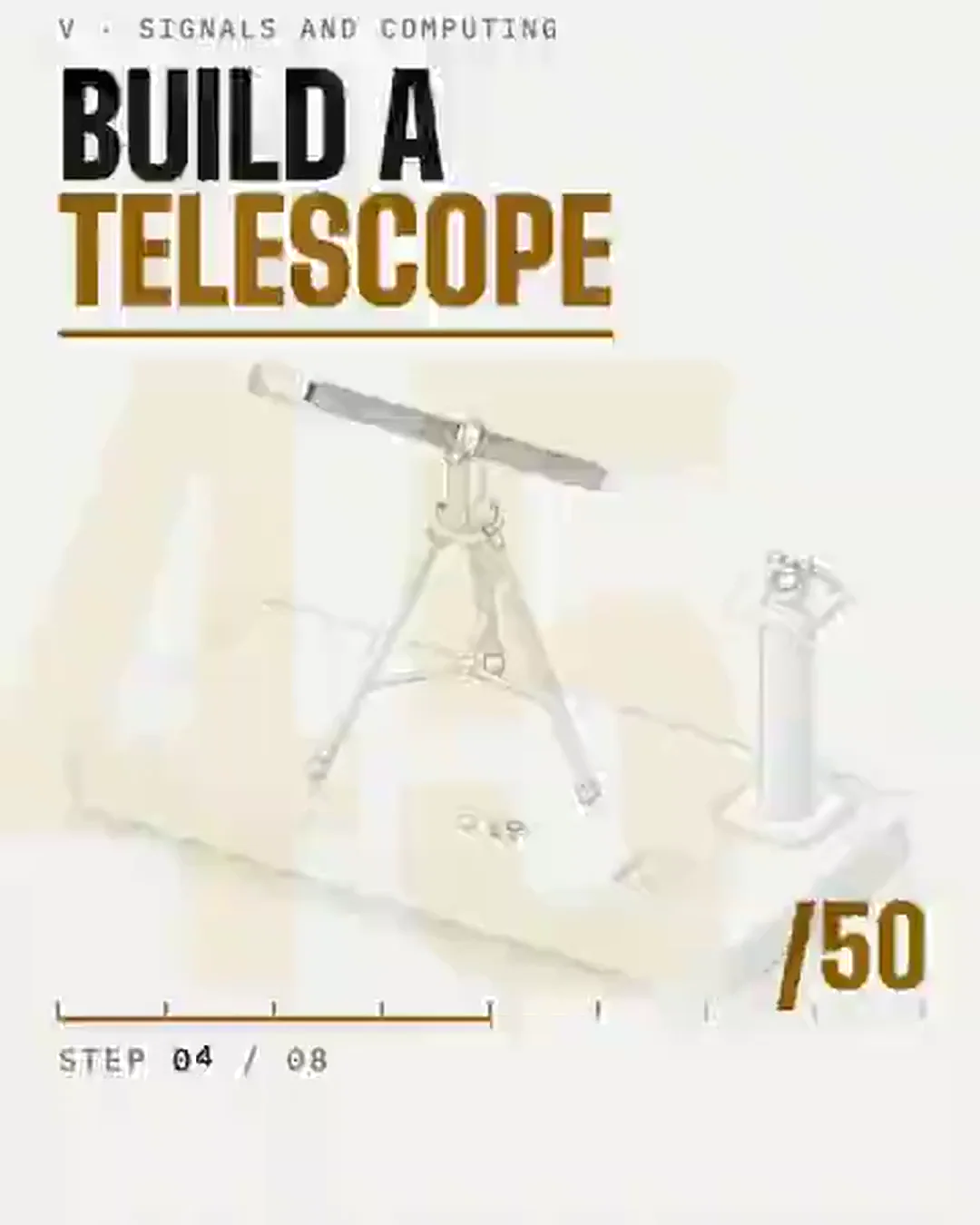
Machine 45Build a telescope← → step through the guidetripod · head 86 cm up
Curveflat
Objective1,000 mm
Magnifies20×
Field15′
Focus—
What this step adds; in part B, the light path through the lensesParts already in placeA Galilean telescope: a 50 mm plano-convex objective of focal length 1,000 mm and a biconcave eyepiece of −50 mm, 950 mm apart for a star. It magnifies f<sub>objective</sub> ÷ f<sub>eyepiece</sub> = 20× and shows the world upright. The lensmaker equation, 1/f = (n − 1)(1/R₁ − 1/R₂), with soda-lime glass at n = 1.52 (assumed), sets the curves: a plano-convex 1,000 mm lens needs one face of radius 520 mm, which over the 56 mm blank is only 0.75 mm deep, and the eyepiece needs 52 mm on both faces. In a Galilean the eye looks through a 2.5 mm image of the objective that lies 47.5 mm inside the eyepiece, so the field is only about pupil ÷ (M × 57.5 mm) = 15′, half the Moon's width (for a 5 mm pupil and the eye 10 mm behind the lens, assumed). That narrow field is why the design stops being practical much past 20×; Galileo's own reached 20–30× in 1609–10. The view card is drawn to scale for a tower 3 km away, and its blur is the defocus a relaxed eye sees. Drawn at 1 unit = 1 cm, larger than most guides, so the lenses read. This is a guide to how the parts go together, not engineering drawings. Never point a telescope or its finder at the Sun, or near it: the objective focuses it to a spot that blinds in an instant.