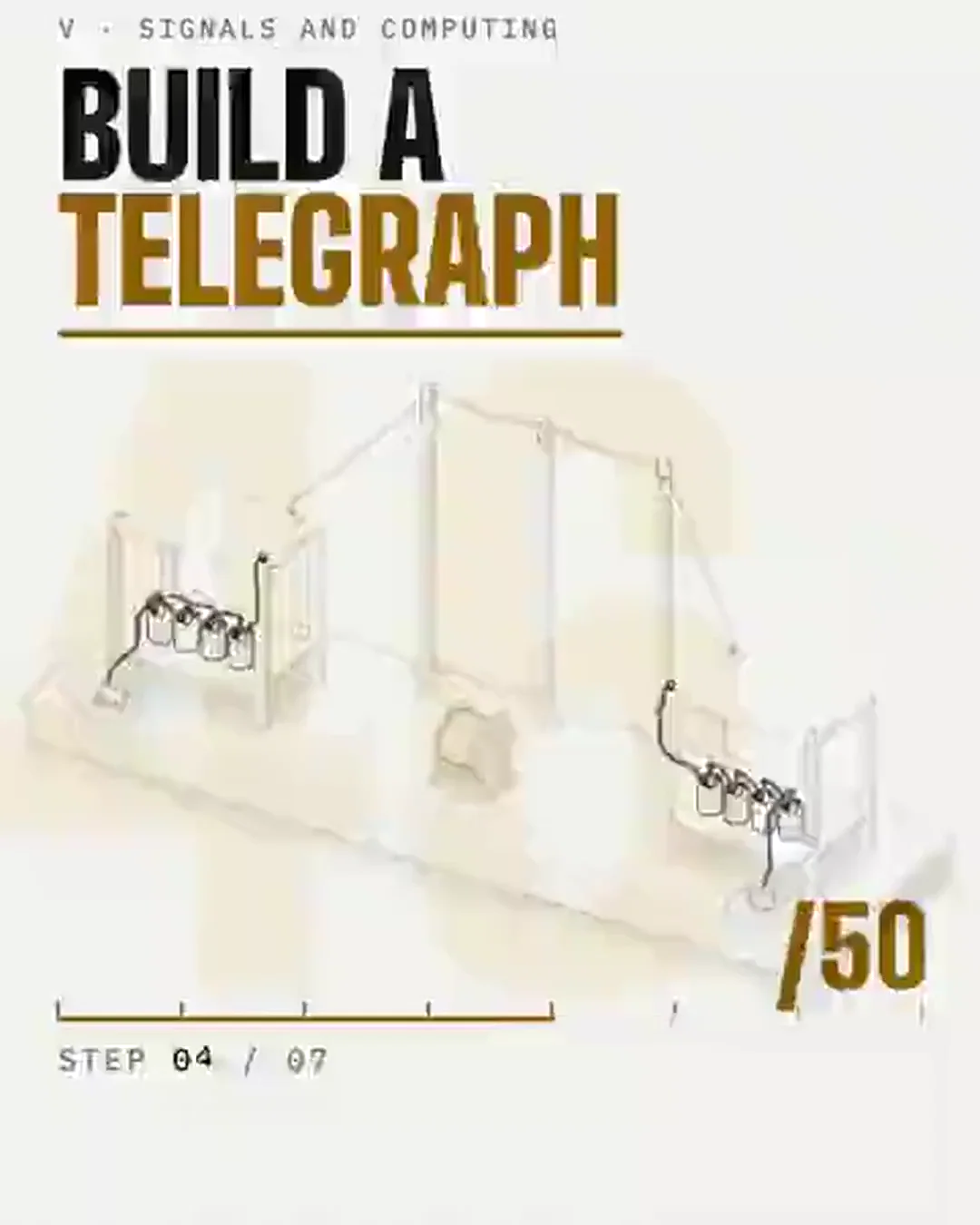
Machine 46Build a telegraph← → step through the guide2 stations · tables 64 × 40 cm
Key–
Line–
Speed–
Unit–
Received–
What this step adds; in part B, current in the lineParts already in placeEach station has a key, 4 Daniell cells of 1.1 V, a sounder and an earth plate; one wire joins them and the earth carries the current back. At rest each key's back contact connects the line to its own sounder; pressing a key lifts it off that and connects the line to its battery instead, so the far sounder pulls in. Current is Ohm's law, I = nE / (nr + R<sub>line</sub> + R<sub>sounder</sub> + R<sub>earth</sub>): on an assumed 10 km line of 2 mm copper (55 Ω), with 0.5 Ω inside each cell, a 20 Ω sounder and 20 Ω for both earths (all assumed), that is 45 mA. If the sounder needs 30 mA these cells reach about 19 km; past that, add cells or a relay. Morse timing: a dot is 1 unit, a dash 3, with gaps of 1 inside a letter, 3 between letters and 7 between words; words a minute = 1.2 / unit. Morse's 1844 line ran 38 miles on poles about 300 ft apart; 10 km at that spacing is about 110 poles. The stations are drawn at true size (1 unit = 1 cm), but the line is drawn short and its poles low, the travel of the key and the sounder is exaggerated, and the pulses are slowed to cross the line in 1.4 s: a real signal crosses 10 km in about 0.03 ms. This is a guide to how the parts go together, not engineering drawings. Keep the line well clear of power lines, and in a thunderstorm disconnect the instruments and earth the line. Copper sulfate is poisonous; wear gloves.