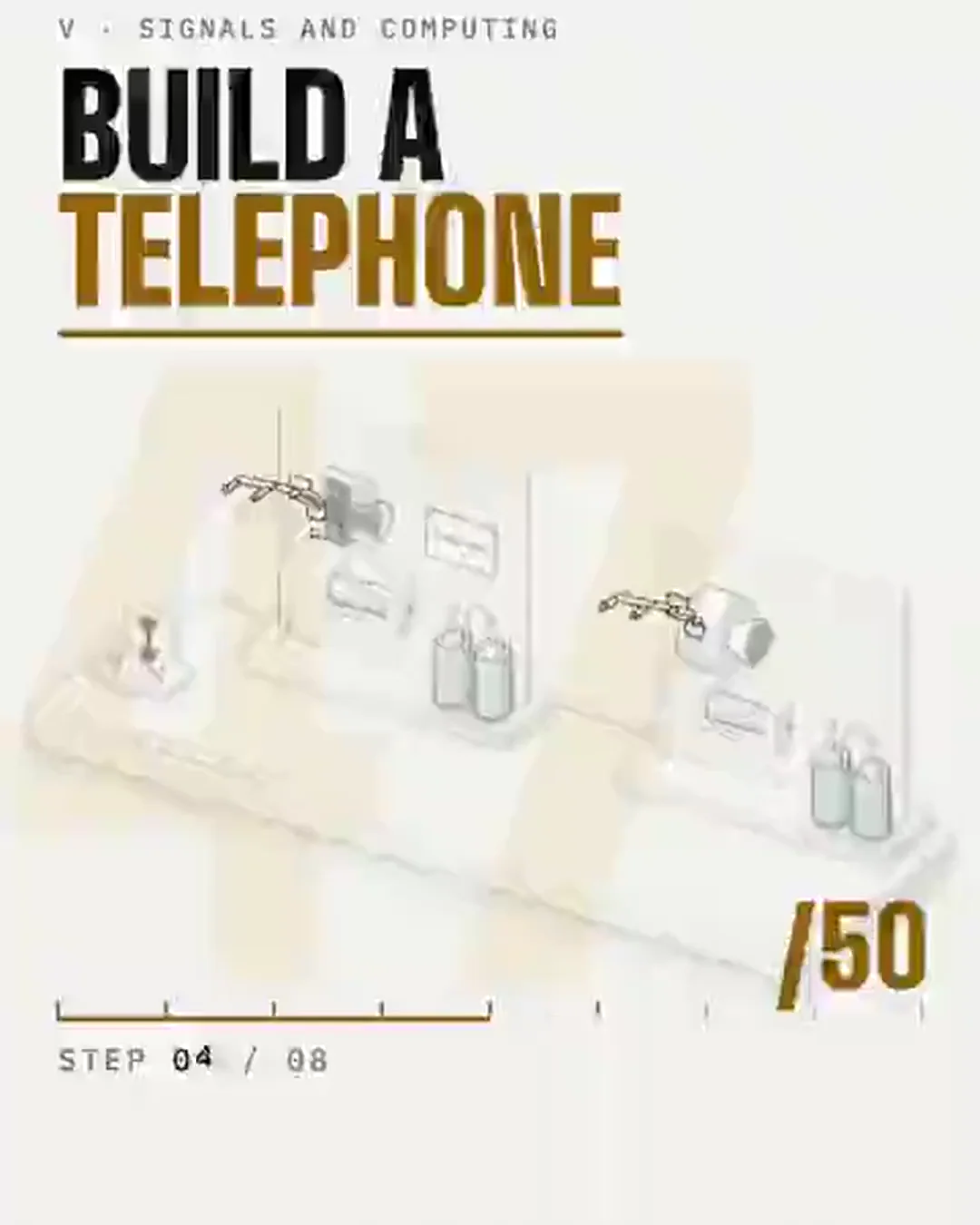
Machine 47Build a telephone← → step through the guide2 boards · 43 × 39 cm
Hookon
Carbon–
Set loop0 mA
Line0 mA
No coil–
What this step adds; in part B, the current: steady in each set, the voice's swing on the lineParts already in placeEach set has its own loop: 2 Daniell cells (2.2 V), the carbon transmitter and the induction coil's thick primary, so I = V / (R_loop + R_carbon(t)) with R_loop = 1.5 Ω. Lifting the receiver lets the hook spring up and close it: 293 mA through 6 Ω of carbon at rest. The voice presses the diaphragm on the granules and their resistance swings about ±20%, so the loop current swings with it; the coil hands only the swing to the line, at 1/20 the current and 20 times the voltage: +2.8 to -2.0 mA through the line, the far coil and the far receiver, and back through the earth. There the current adds to and takes from the pull of a permanent magnet, and the iron diaphragm moves in step. Without a coil the 2 km line (11 Ω of 2 mm copper), the earth and two 75 Ω receivers sit in the transmitter's own loop, I = V / (R_line + R_carbon(t)) with R_line ≈ 172 Ω, and the same voice moves its 12 mA by only ±0.08 mA: the coil gives about 33 times the swing. Hughes showed in 1878 that loose carbon contacts do this; he coined the word microphone and never patented it, and Edison disputed who came first. The resistances, the coil's ratio and the depth of the swing are assumptions; the wave is drawn slowed down (a voice moves the diaphragms hundreds of times a second) and the diaphragms' motion many times larger than it is. Drawn at 1 unit = 5 mm, with the line and the pole shortened. This is a guide to how the parts go together, not engineering drawings. Keep the line wire clear of power lines and disconnect it in a thunderstorm; copper sulfate is toxic, so wear gloves with the cells.