Machine 20Build a steam engine← → step through the guidefoundation · 1.64 × 0.4 m
Boiler0.0 bar
Water15 °C
Steam chest0.0 bar
Engine0 rpm
Indicated0.0 kW
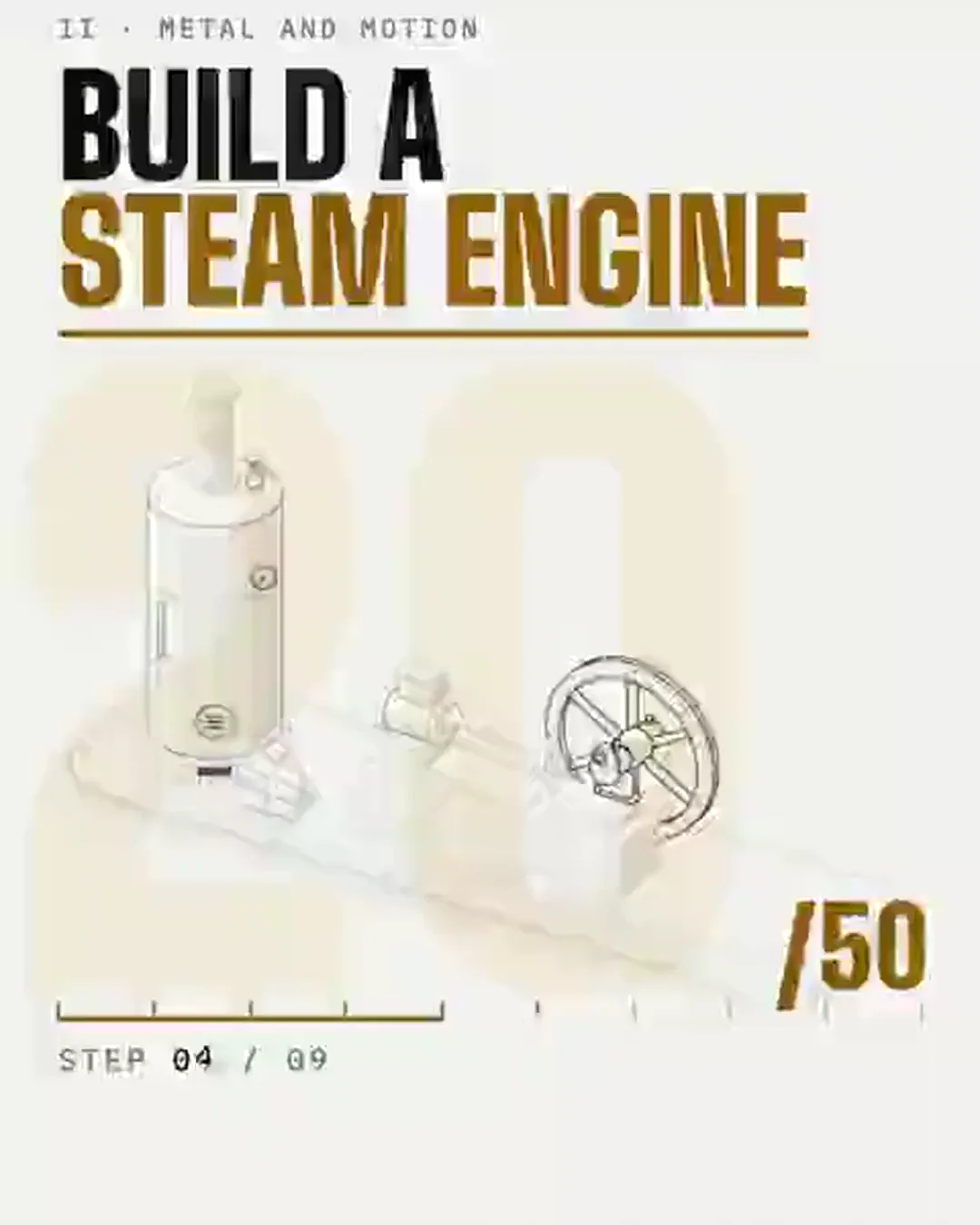
What this step adds; in part B, live steamParts already in placeA vertical fire-tube boiler 0.7 m across and 1.5 m tall, holding about 250 kg of water, feeds a horizontal double-acting engine with a 12 cm bore and a 20 cm stroke. Indicated power is P = p<sub>mean</sub> × A × L × n × 2, both sides of the piston working each revolution. The model's assumptions: boiler at 6 bar, safety valve set at 7 bar; the throttle and governor valve cut the steam-chest pressure in proportion to their opening; the slide valve cuts off at 60% of the stroke and the steam then expands hyperbolically, so p<sub>mean</sub> = 0.7 × (p₁·c·(1 + ln 1/c) − p<sub>air</sub>), the 0.7 standing for the losses a real indicator card shows; exhaust to the open air; saturation pressure from Antoine's equation for water. With no work on the shaft it runs at about 186 rpm on 0.8 kW; with a 120 N·m load the governor holds about 177 rpm and the cylinder gives 2.9 kW (3.9 hp), close to the ≈ 5 hp of a Newcomen pumping engine from a cylinder a fraction of its size. Raising steam from 15 °C with 50 kW going into the water takes about 52 minutes; the clock runs 900 times fast while it does, and the drawing turns at a third of true speed. Steam use leaves out cylinder condensation and leaks, so a real engine burns more. Drawn at 1 cm to the unit, finer than the 2.5 cm of the plant guides. This is a guide to how the parts go together, not engineering drawings. Boilers explode. Never build or run a pressure vessel without a safety valve tested to lift at its set pressure, a cold-water hydrostatic test well above working pressure, and inspection by a qualified boiler inspector, and never let the water drop out of the glass.