Machine 21Build a battery← → step through the guidebench · 93 × 51 cm
Cells0
EMF0.0 V
Meter0.00 V
Current0 mA
Bulbdark
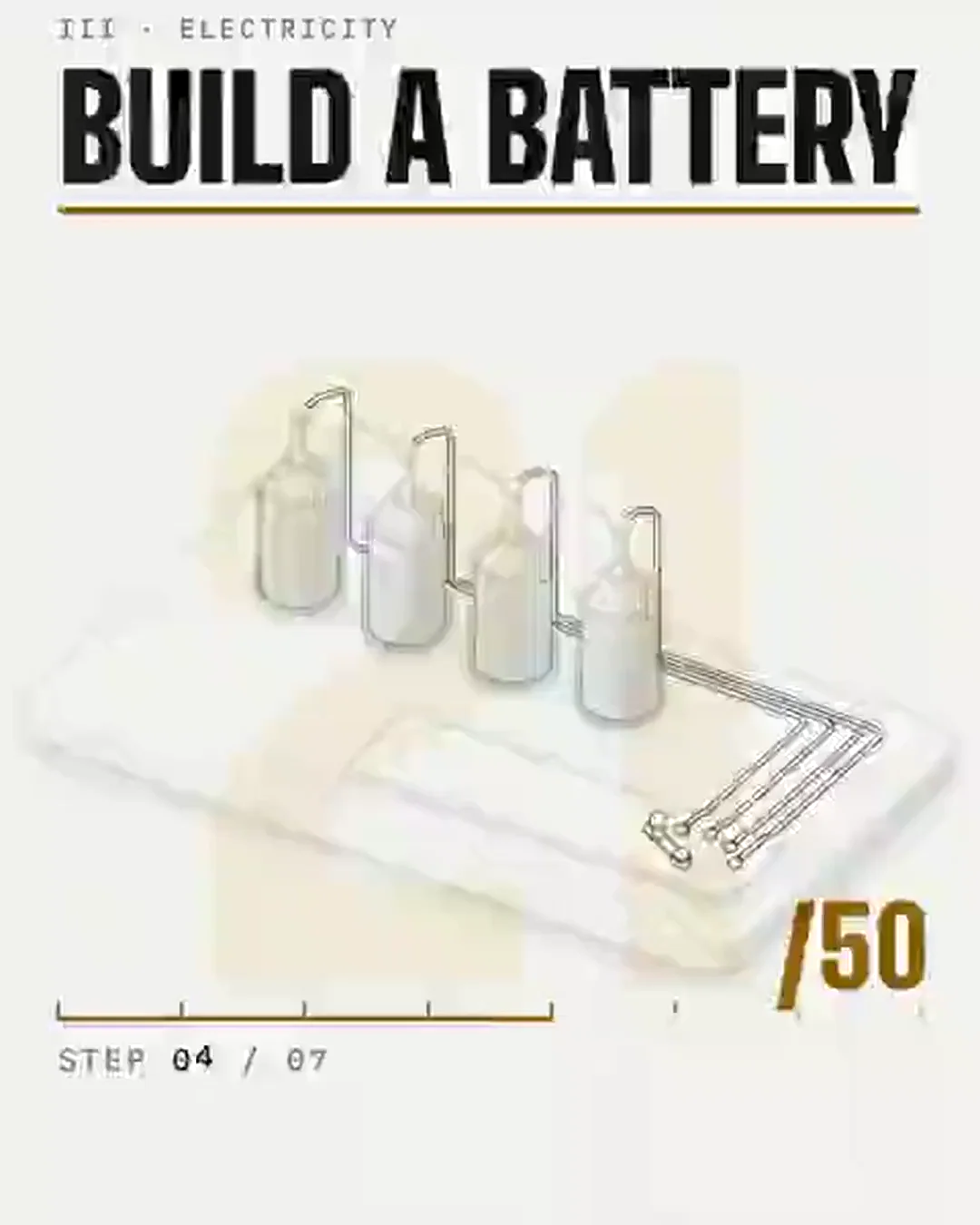
What this step adds; in part B, the current's path and the bulbParts already in placeA Daniell cell gives 1.10 V: copper in copper sulfate, zinc in zinc sulfate, the two liquids kept apart by an unglazed clay pot. Cells in series add, so the tapping switch puts 1.1 V more into the circuit at each stud, up to 4.4 V for all four jars. The bulb is a 2.5 V 0.3 A torch bulb on a voltmeter, and the current is Ohm's law round the loop, I = n × 1.1 / (n × r + R), so the meter reads a little less than the jars' sum: 0.93, 1.62, 2.14 and 2.56 V. The model assumes about 1.5 Ω inside each jar (it depends on the jar and the pot), takes the bulb as a steady 8.3 Ω, and counts it lit from half its rated 0.75 W, which it reaches with 3 jars. Volta's pile beside it, 8 zinc, brine-cloth and copper cells, gives about 0.76 V a cell with no current drawn, 6.1 V in all, and fades as hydrogen gathers on its copper: the problem Daniell's pot solved. Drawn at 1 unit = 5 mm on the bench. This is a guide to how the parts go together, not engineering drawings. Copper sulfate is toxic: wear gloves and eye protection, keep it from children, animals and food, and never pour it on the ground or down a drain.