Machine 28Make a light bulb← → step through the guidebench · 90 × 40 cm
Pressure1,013 mbar
Strokes0
Current0.00 A
Filament20 °C
Glowdark
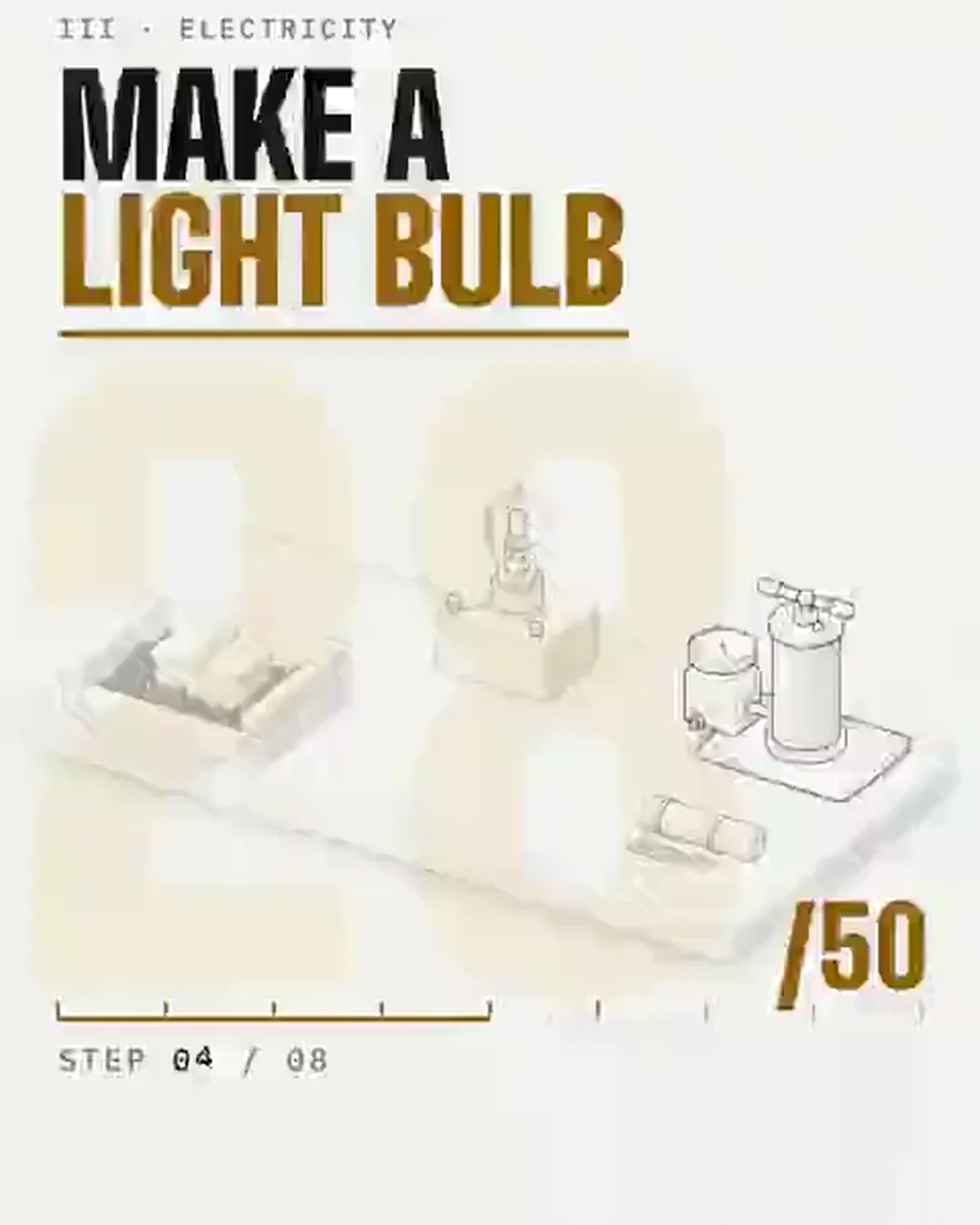
What this step adds; in part B, the current and the glowing filamentParts already in placeEach stroke of the pump shares the gas in the 145 mL bulb and its hose with the 149 mL the piston sweeps (Boyle's law), so the pressure roughly halves at every stroke: 8 strokes take it below 10 mbar. A piston pump can never beat its own dead space: with 0.15 mL left under the piston (assumed) the best it can reach is 1,013 × 0.15 / 149, about 1 mbar, a much coarser vacuum than the mercury Sprengel pump gave Swan and Edison, so expect a hand-pumped lamp to live far short of the 1,200 hours carbonised bamboo reached (Edison's first carbonised thread of 1879 lasted 14 to 40 hours). In the empty bulb the filament can only lose heat by radiating it, so it settles where I²R equals 0.8 σ A T⁴. The model assumes a hairpin 48 mm long and 0.15 mm thick, 4 Ω cold falling to 2.4 Ω at 2,000 K, as carbon's resistance falls when hot, on 3 lead-acid cells (6.3 V) through a 10 Ω rheostat: from 654 °C (dull red) with all the coil in to 1,729 °C (yellow-white, 17 W, 2.6 A) with none. A hot body first glows at about 525 °C. Drawn at 1 unit = 2 mm, finer than the other guides, so a 6 cm bulb reads. This is a guide to how the parts go together, not engineering drawings. Hot glass and the charcoal fire burn, and an evacuated bulb can implode and throw glass: wear eye protection and keep a guard round the bulb while it is under vacuum. The historical Sprengel pump used mercury, which is toxic, so this guide uses a piston pump.