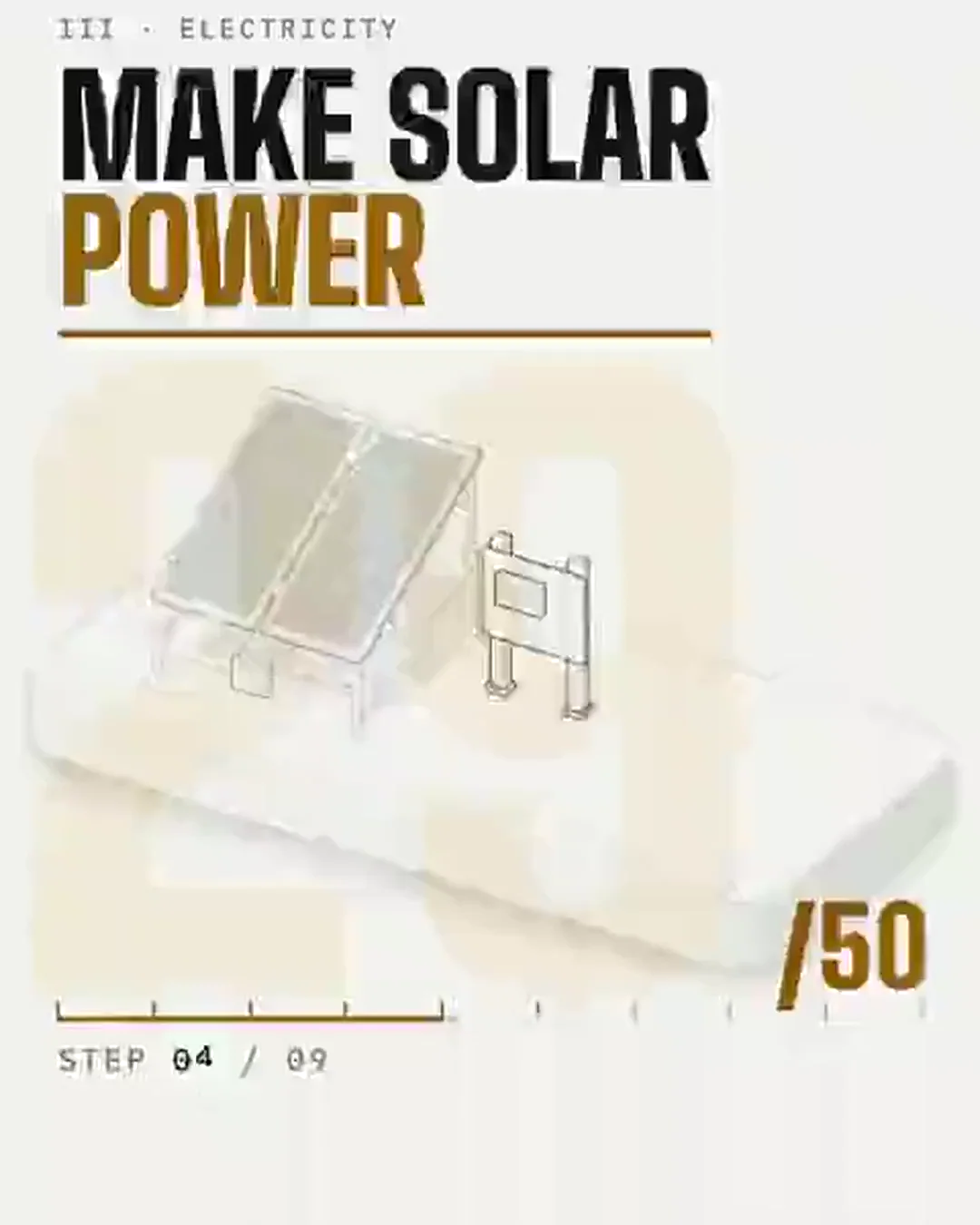
Machine 29Make solar power← → step through the guidesite · 4.0 × 1.85 m · faces south
Sun time12:00
Sun height60°
On panels964 W/m²
Panels—
Charging—
Jar cell—
What this step adds; in part B, live currentParts already in placeTwo salvaged 36-cell panels, each 54 × 120 cm (0.65 m²), on a rack tilted 30° to face due south at latitude 30° on the equinox. Panel power is irradiance × area × efficiency × cos(angle to the sun): the model takes direct sunlight from the Kasten–Young air mass and Meinel's 0.7^(AM^0.678), scaled to 1,000 W/m² with the sun overhead, ignores haze and diffuse light, and assumes 15% efficiency (salvaged modules are 15–20%) and an MPPT controller charging at 14 V with no losses. At noon that is about 187 W, 13.4 A. The jar cell is the kitchen copper-oxide cell measured at scitoys.com: about 6 µA in shade (it is also a weak salt-water battery) and 33 µA in bright sun, at best 50 µA at 0.25 V, 12.5 µW from about 0.01 m². Per square metre in full sun that is about 1.25 mW, against 10 W for Fritts's 1883 selenium cell (≈ 1%) and 150 W for the panels: the panels give about 120,000 times more. The jar proves the effect; it will never charge a battery, and making silicon cells is out of reach for a long time, so salvage panels first. This is a guide to how the parts go together, not engineering drawings. Fuse the battery lead next to the battery: a shorted 12 V battery can weld a spanner. Cover the panels while you wire them, since they are live in daylight, and handle the red-hot copper with tongs.