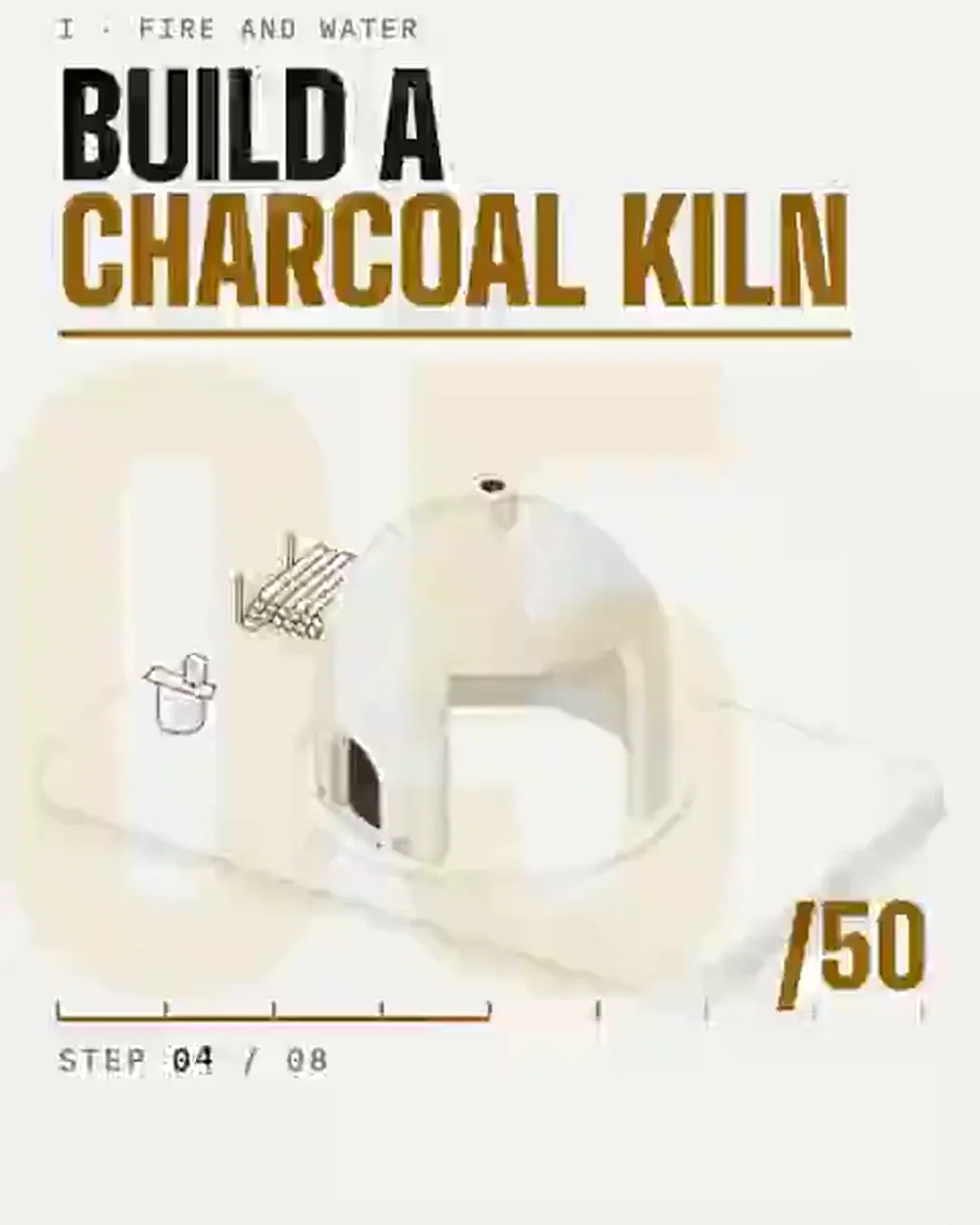
Machine 05Build a charcoal kiln← → step through the guidefooting · Ø 3.65 m
Time0 h
Smokenone
Carbonised0%
Wood in9,650 kg
Charcoal0 kg
What this step adds; in part B, the carbonising frontParts already in placeA small beehive kiln, 2.8 m across inside and 2.57 m to the crown, one brick (22.5 cm) thick; FAO's production brick kilns are bigger, 50–130 m³. Stacked full it holds about 12 m³ of wood. FAO's Mozambique figures (128 kg of charcoal per stacked m³ at 16%) put that at about 800 kg a cubic metre, so 9,650 kg goes in. FAO gives brick kilns about 20% by weight, so about 1,930 kg comes out; traditional kilns reach about 25% and retorts 35–40%, while earth mounds have measured anywhere from 7.5% to 21%, mostly on the burner's skill. Wood browns near 220 °C and goes dark and friable at 280–310 °C; the charcoal then burns above 1,100 °C. The hours are the model's assumption, inside FAO's 9–25 day cycle for brick kilns: 6 hours for the fire to reach the crown, the front down through the stack by hour 112, sealed by hour 120, opened on day 11. The model grows the front as an ellipsoid from the crown and counts charcoal in proportion to the wood it has passed; the smoke colours are the burner's traditional signs. This is a guide to how the parts go together, not engineering drawings. A burning kiln gives off carbon monoxide, which you cannot see or smell: burn it in the open, never enter a kiln that has not fully cooled and aired, and keep water, a clear firebreak and no dry brush around it.