Machine 06Build a lime kiln← → step through the guidefooting · 2.55 × 2.55 m
Burning zone20 °C
Stone in0 kg
Quicklime out0 kg
CO₂ given off0 kg
Slaked lime0 kg
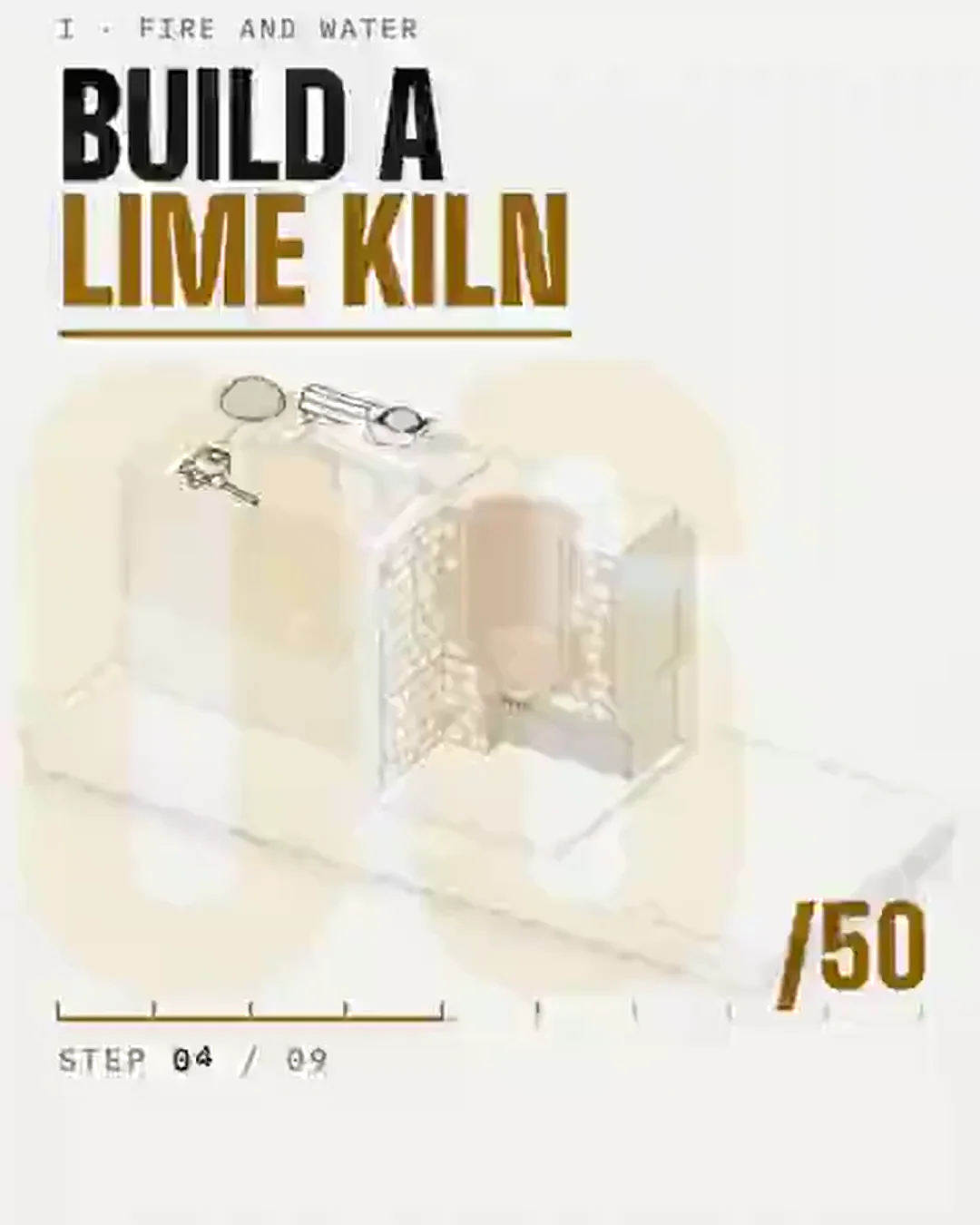
What this step adds; in part B, the heatParts already in placeA mixed-feed draw kiln: a stone tower 2.4 × 2.4 m and 2.75 m tall, built into a bank so it is charged from the top, with a pot Ø 1.1 m lined in firebrick from kiln #1. Limestone broken to 40–150 mm goes in with layers of wood or charcoal; above about 900 °C it gives off its CO₂ (CaCO₃ → CaO + CO₂), and small kilns are run near 1,000 °C. Too hot or too long gives dead-burned lime that will not slake. About 1.75 kg of stone gives 1 kg of quicklime, so 43% of the charge's weight leaves as gas. Theory needs about 720 kcal (3.0 MJ) per kg of lime and a good modern kiln uses 4–5 MJ; a small kiln uses more. Slaking is CaO + H₂O → Ca(OH)₂: by the molar masses each kg of quicklime takes 0.32 kg of water, gives 1.32 kg of slaked lime and about 1.16 MJ of heat, enough to boil the water. The model's own assumptions: one 70 kg barrow of stone tipped in per draw (so 40 kg of lime out), a burning zone that stays in the middle of the shaft while the charge sinks through it, and how fast the fire comes up. The sizes are illustrative. This is a guide to how the parts go together, not engineering drawings. Quicklime and slaking lime burn skin and eyes violently: wear goggles, gloves and long sleeves, keep water away from stored quicklime, and slake in the open, never in a closed tub. A burning kiln gives off carbon monoxide and CO₂: never stand over the charging hole or lean into the draw arch while it burns, and keep children and animals away.