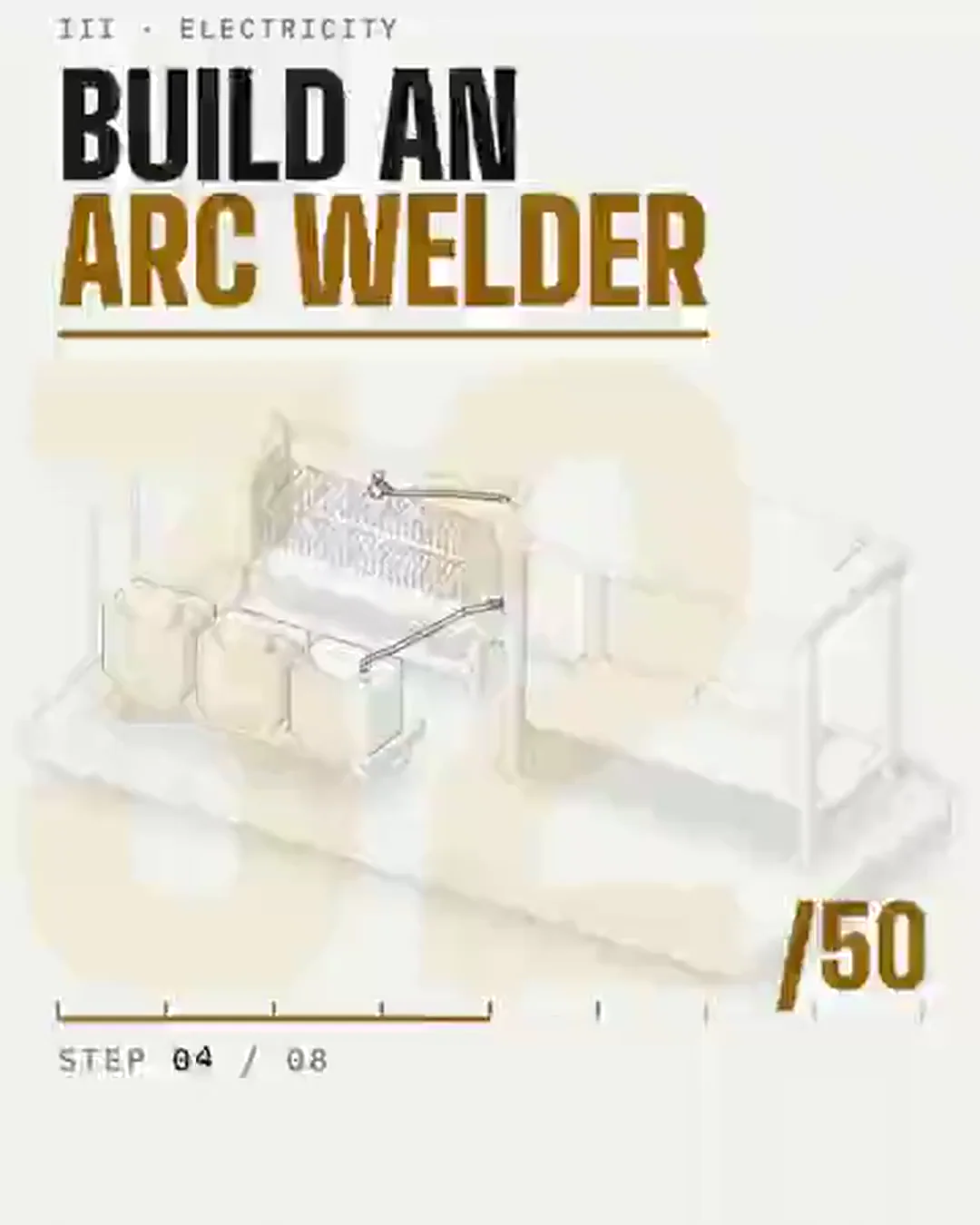
Machine 32Build an arc welder← → step through the guidebench · 96 × 48 cm · top 73 cm
Tap3 of 5
Current0 A
Volts37.8 V
Rod left32 cm
Bead0 cm
What this step adds; in part B, the current and the arcParts already in placeThree 12 V lead-acid batteries in series give about 36 V under a welding load (37.8 V at rest). A stick arc burns at 20–25 V, so the rest has to be dropped in a resistance: two coils of 5 mm mild-steel wire, 27 turns 10 cm across, about 8.5 m and 0.06 Ω each when cold. The current is Ohm's law round the loop, I = (36 V − V<sub>arc</sub>) / R, with the arc on the welding standard's load line, V<sub>arc</sub> = 20 V + 0.04 V/A × I, and R the coil in circuit plus about 0.02 Ω in the batteries and cables. The tap clamp leaves 94% down to 6% of the top coil in circuit, for 90, 98, 106, 117 and 129 A; a 3.2 mm rod wants about 90–130 A. At tap 3 the arc takes about 2.6 kW and the coil turns another 1.0 kW into heat. The model assumes the rod melts about 5 mm a second at 110 A, in proportion to the current, from 35 cm down to a 5 cm stub, while the bead advances 15 cm a minute; it ignores the coil's resistance rising as it heats and the batteries sagging as they drain. The run is shown 8× faster than real time. Drawn at 1 unit = 1 cm. This is a guide to how the parts go together, not engineering drawings. Never look at the arc, even for a moment, without a welding helmet with a shade 10 or darker filter: its ultraviolet burns eyes and skin in seconds. Batteries give off hydrogen, which explodes: keep the trolley well away from the arc and sparks, and never make or break a cable on a battery post under load. Spatter starts fires: clear anything that burns, keep the sand bucket at hand, and weld where fumes can clear.