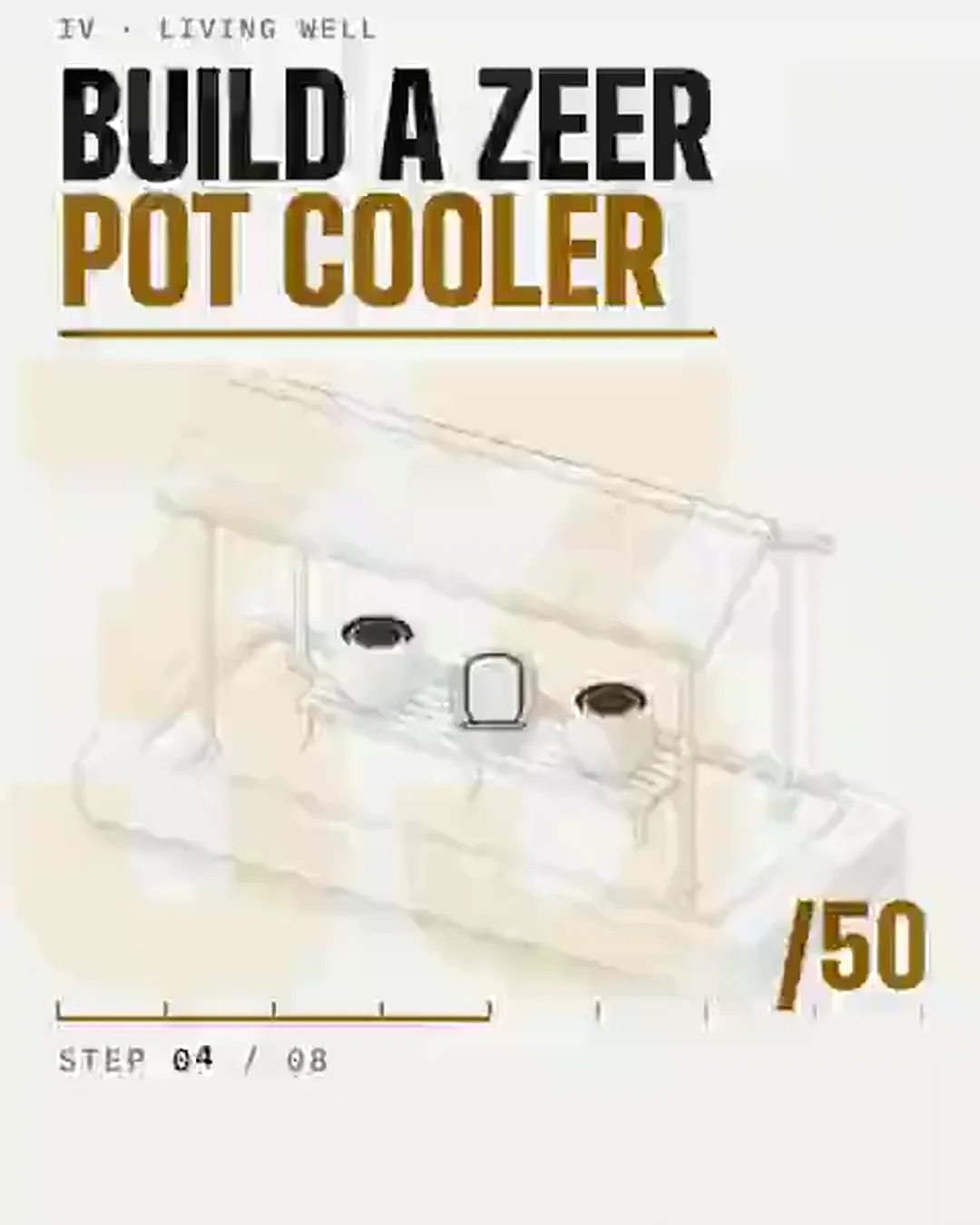
Machine 33Build a zeer pot cooler← → step through the guideshade · 4 poles · 1.85 m · tile floor
Time06:00
Air, shade25 °C
Humidity33%
In the pot25 °C
Sand water100%
Tomatoes20 d vs 2
What this step adds; in part B, the evaporating water and the cool insideParts already in placeTwo clay pots, one inside the other, with wet sand between them and a wet cloth on top: water soaks out through the unglazed outer pot and evaporates, and each litre that evaporates takes about 0.68 kWh of heat with it. In Practical Action's trials in Sudan, tomatoes kept 20 days in a zeer and 2 without one (Cooper Hewitt gives 21 days instead of 2–3); the design is Mohammed Bah Abba's, from 1995. The sources give no inside temperature, so the cooling here is this model's physics: the wet pot heads toward the air's wet-bulb temperature (Stull's formula), and the model assumes it gets 60% of the way there while the sand is wet, with a 1.5 h lag. The day is the model's too: 25–40 °C in the shade with the dew point held at 8 °C, so the air is 15% humid at its hottest and the pot runs up to 13 °C cooler. Evaporation is h·A·ΔT / L with h = 12 W/m²K over 0.8 m² of wet pot; the sand holds 2.5 L, cools less once it falls below 50% and is topped up at 30%. In humid air the drop shrinks toward nothing. Pots 56 cm and 38 cm across, with 5–7 cm of sand between. This is a guide to how the parts go together, not engineering drawings. Keep the water clean and the pots scrubbed, and do not store raw meat or milk in a zeer: it slows spoiling, it does not keep food as cold as a refrigerator.