Machine 11Make copper wire← → step through the guidebench · 2.0 m × 42 cm
Hole1 of 24
WireØ 3.00 mm
Length2.0 m
Since anneal0 passes
Coppersoft
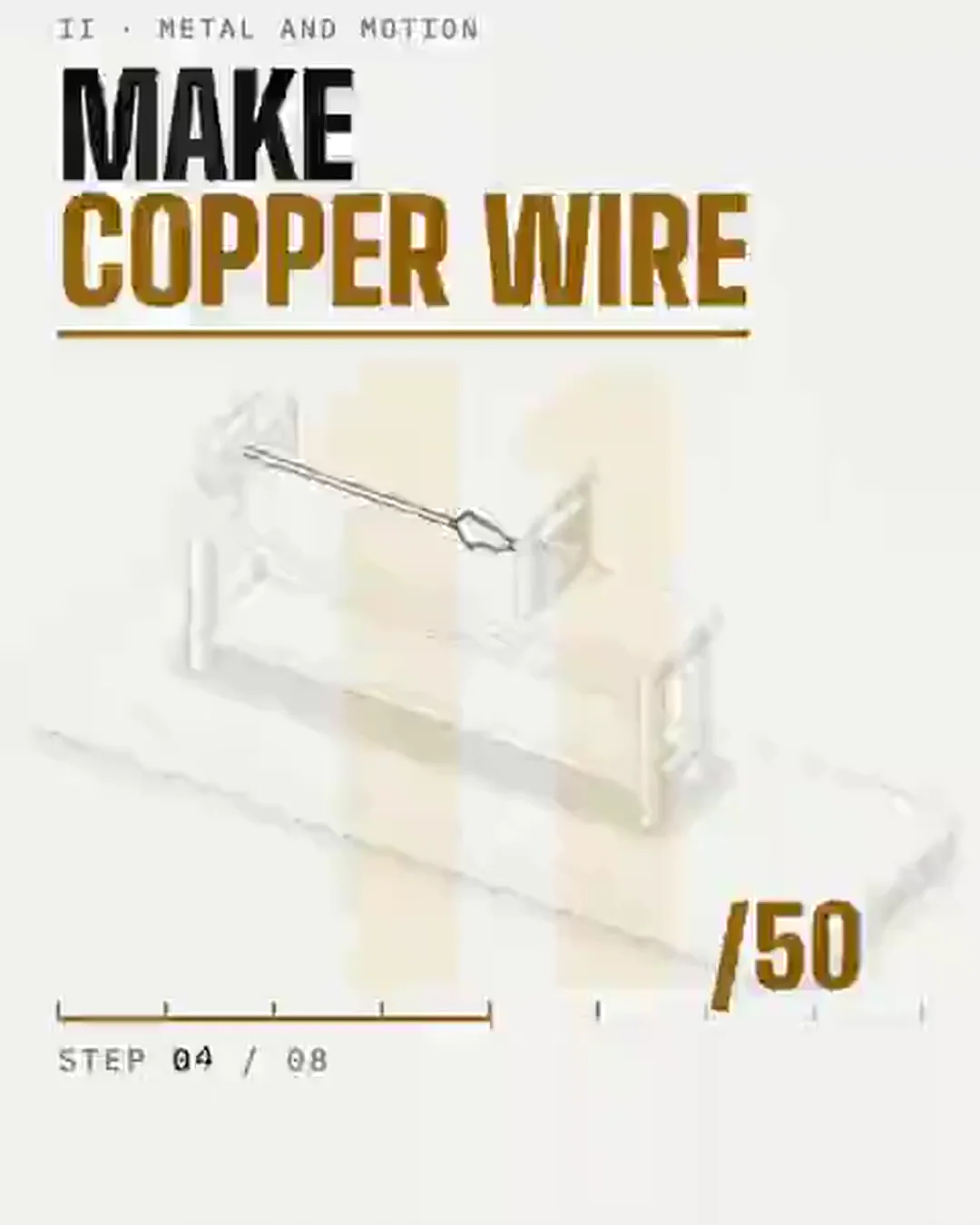
What this step adds; in part B, the copperParts already in placeA hand draw bench 2.0 m long, drawn at 1 unit = 1 cm (closer than the other guides, so the plate's holes show; the wire and the holes are still drawn thicker than scale). Drawing wire through a plate is described from the 12th century; plates had 20–30 holes, and the wire is re-annealed about every 3 passes because it work-hardens. This plate has 24 holes from 2.68 to 0.21 mm, each taking 20% off the area (the notes give 15–25% a pass for small wire), so three passes take off 49%, about the 50% at which drawn copper should be annealed. Drawing keeps the volume, so length × (d_old / d_new)²: 2 m of 3 mm rod becomes 18.6 m of 0.98 mm wire after 10 holes, and both weigh about 127 g. Assumed: the rod's size and length, 20% per hole, and an anneal at about 600 °C, a dull red (hot metal starts to glow near 525 °C). The figure shows each pass as one pull and keeps the coil on the feed side; on the bench a long wire takes several pulls, re-gripping at the plate, and is coiled up and carried back for the next hole. This is a guide to how the parts go together, not engineering drawings. Anneal outdoors or under a chimney, since a charcoal fire gives off carbon monoxide; handle the hot coil with tongs; and stand to the side of the line of pull, because a strap or a wire that breaks under load whips back.