Machine 39Build a Stirling engine← → step through the guidebase · 75 × 30 cm
Hot end20 °C
Cold end20 °C
Engine0 rpm
Indicated0.0 W
LED0.00 W
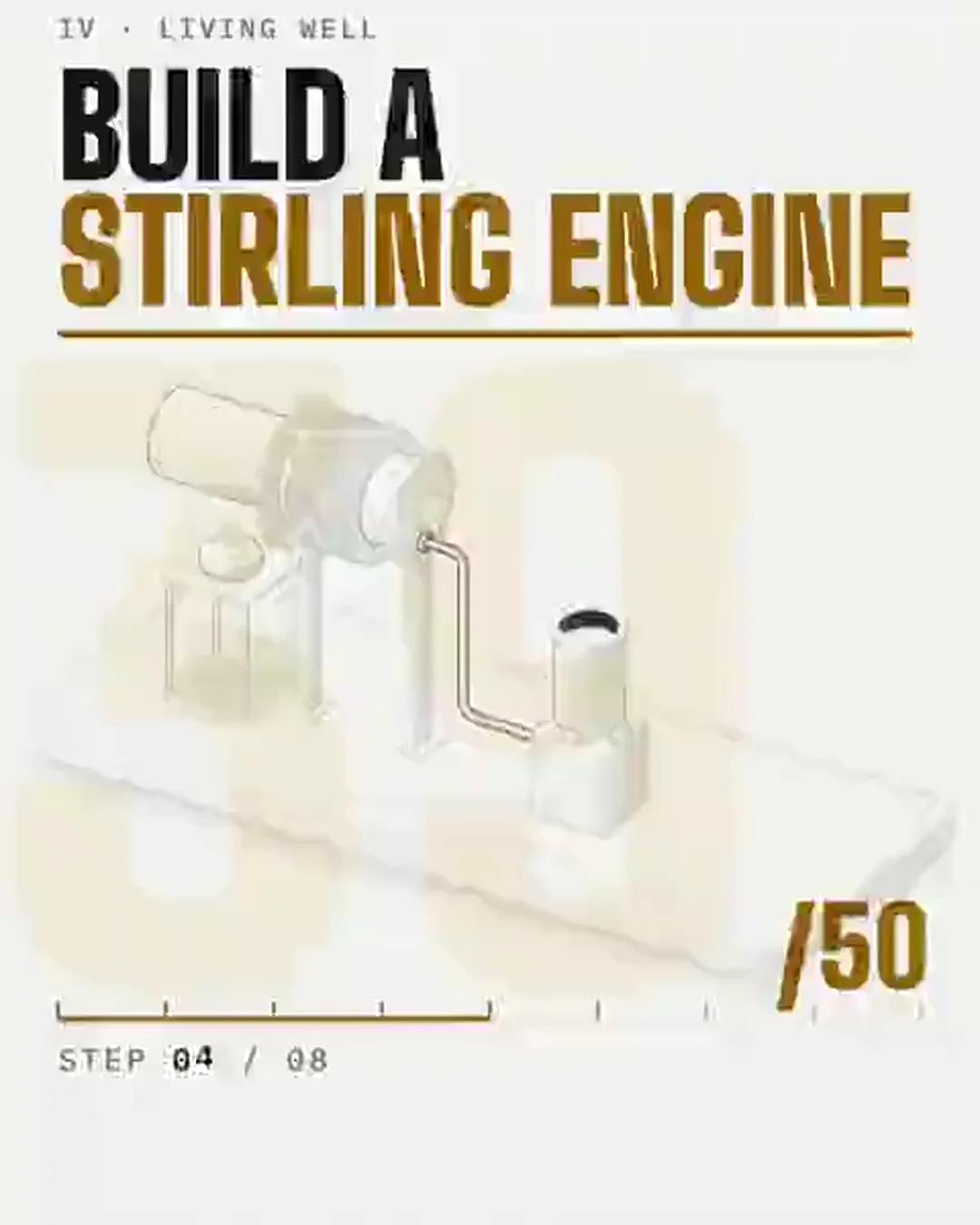
What this step adds; in part B, the heat at the hot endParts already in placeA gamma Stirling engine: a 8 cm displacer cylinder over a spirit lamp, a 5 cm bore × 4 cm stroke power cylinder joined to it by a transfer pipe, one crank pin working both rods a quarter turn apart, and a 24 cm flywheel belted 12:1 to a small generator with an LED. Power is the Beale estimate P = Bn · p · f · V, with Bn ≈ 0.015 (p in bar, V in cm³, f in Hz) for a hot end near 650 °C, scaled by (T<sub>hot</sub> − T<sub>cold</sub>)/(T<sub>hot</sub> + T<sub>cold</sub>) in kelvin when it runs cooler. The model's assumptions: plain air at 1 bar mean pressure; 78.5 cm³ swept by the power piston; full flame holds the hot end at 500 °C and the finned cold end rises 7.000000000000001% as far; 0.07 N·m of friction that the gas must beat, so it keeps going only once the hot end passes about 157 °C, and only after a flick; drag that grows with speed; a generator that passes 60% of what it takes to the LED. At full flame it runs about 399 rpm free and 189 rpm with the LED on, 3.2 W indicated and 0.59 W to the LED. Robert Stirling's 1818 engine made about 2 hp (≈ 1.5 kW) pumping water at a quarry; a hobby engine on a candle makes about 1.5 W. The hot end warms 75 times fast, and the drawing turns at a third of true speed. Drawn at 2 mm to the unit, finer than the 2.5 cm of the plant guides. This is a guide to how the parts go together, not engineering drawings. The hot end and the lamp burn on contact, and a spirit flame is nearly invisible in daylight: refuel only when cold, keep the snuffer and a damp cloth at hand, guard the belt, and never pressurise the engine: a charged Stirling is a pressure vessel.