Machine 36Build a solar water heater← → step through the guidestand · 30° · faces south
Sun time—
On glass—
Efficiency—
Into water—
Loop flow—
Tank—
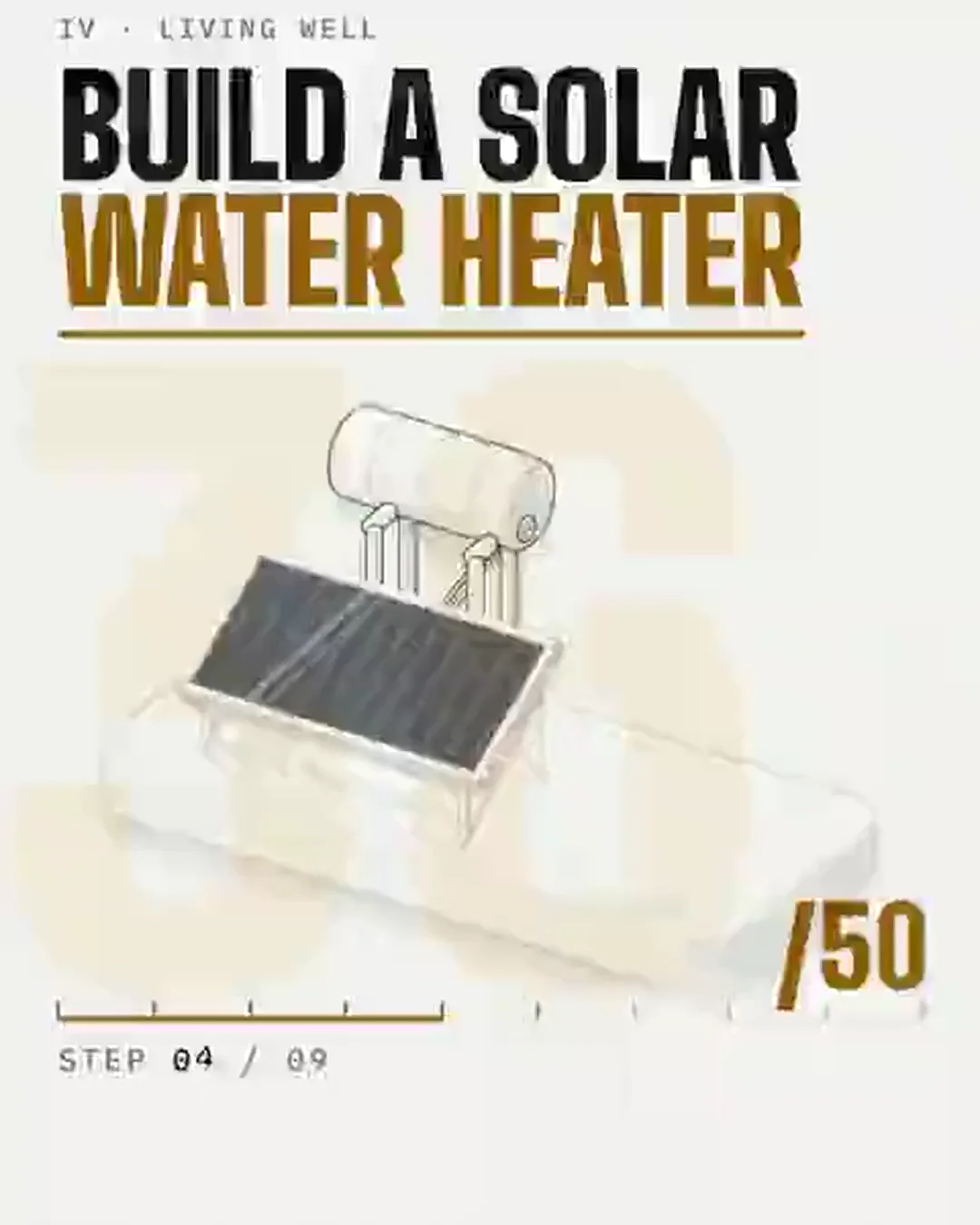
What this step adds; in part B, the heat and the moving waterParts already in placeA glazed flat plate, 2.0 × 1.0 m with 1.77 m² of glass, tilted 30° to face due south at latitude 30° on a clear equinox day, under a 150 L tank. Power into the water is irradiance × area × η, and η falls as the plate gets hotter: the model uses the usual straight line for a single-glazed, black-painted plate, η = 0.7 − 5 × (tank − air) / irradiance, with the tank's water taken as the plate's inlet. Sunlight is the direct beam only (Kasten–Young air mass and Meinel's 0.7^(AM^0.678), 1,000 W/m² with the sun overhead, no haze or diffuse light). At noon that is 964 W/m² on the glass, η 59%, about 1,009 W. Hot water rises by itself: the model makes the loop flow grow with the square root of the power (laminar thermosiphon), set to 1.2 L/min at 1 kW, and the flow marks move faster with it. It also assumes air and mains water at 20 °C all day, a fully mixed tank that starts at 20 °C and loses 2 W per degree, and one 10-minute shower at 40 °C and 6 L/min at 19:00. The tank peaks near 55 °C after about 6.5 kWh, with no fuel; a real tank stratifies, so its top is hotter than this. This is a guide to how the parts go together, not engineering drawings. Water from the tank can pass 55 °C and scalds in seconds at 60 °C: open the cold valve first and mix down to about 40 °C before you step under it. Where it freezes, shut the cold feed and open the drain cock before a frosty night, or a frozen riser splits.