Machine 12Build a pole lathe← → step through the guidebed · 1.5 m · slot 11 cm · top 86 cm
Strokeidle
Strokes0
Turns a stroke–
Work speed–
Ø at the cord–
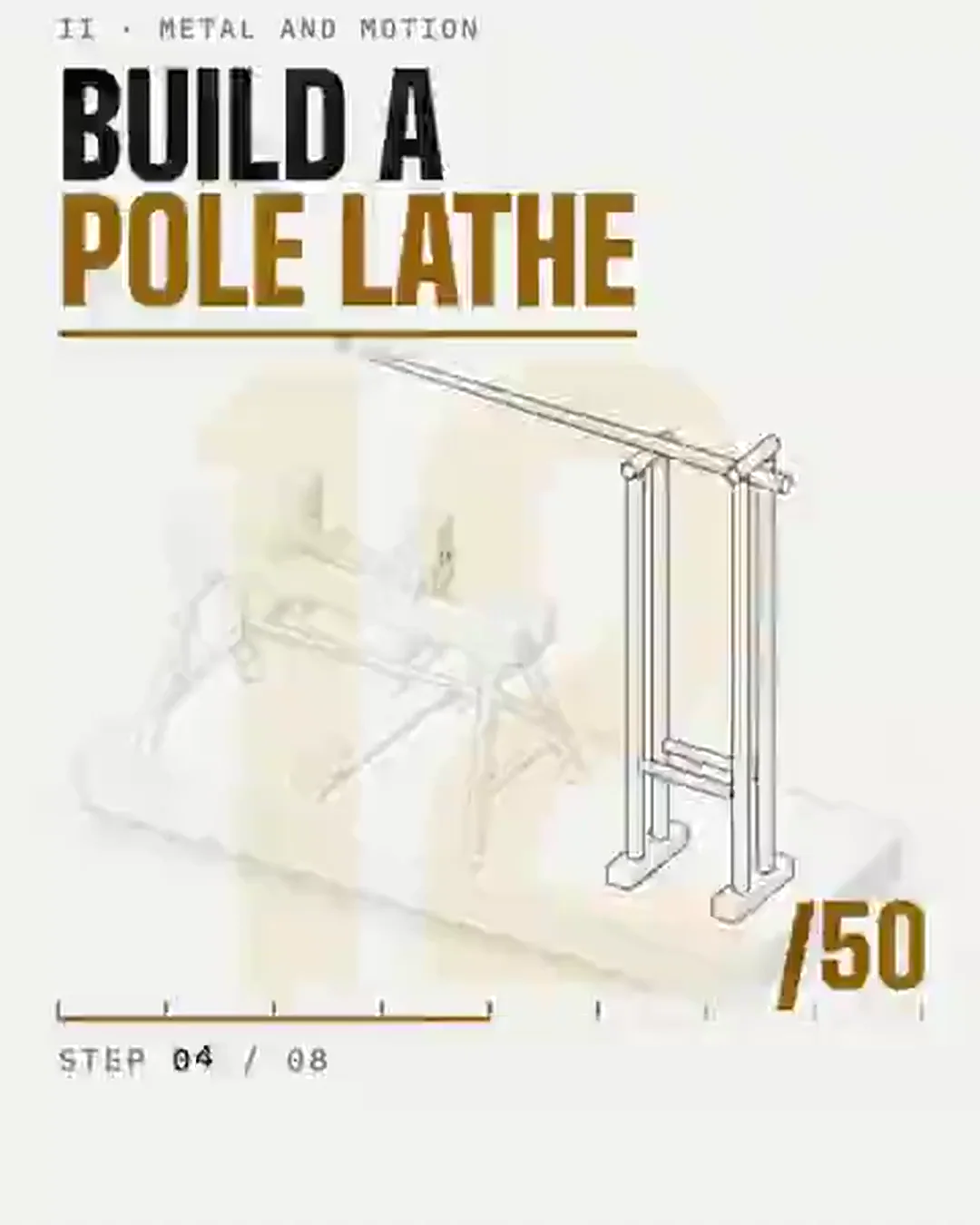
What this step adds; in part B, the cutting edge and the shavings it liftsParts already in placeA spring-pole lathe, drawn at 1 unit = 1 cm rather than the series' 2.5 cm so the work and the tools can be read; the centres stand 100 cm up and hold a 45 cm billet. The research behind this series found no sourced figures for pole lathes, so every number here is read off the drawing or a stated assumption. The model's one rule is that the cord does not slip: the treadle pulls 29.5 cm of cord a stroke (its tie point drops that far), so the work turns cord travel ÷ circumference times a stroke, 1.3 on the axed octagon (21.9 cm round), 1.8 on the Ø 5.2 cm blank and 2.3 on the finished leg. Taking 0.5 s for the cutting stroke and 0.5 s for the return (an assumption, about one stroke a second), that is 162, 217 and 281 rpm on average while it cuts, and the surface under the cord moves at 0.6 m/s whatever the diameter; on the return the pole spins it back the same number of turns. The motion is drawn at half speed. The shaping is sped up: the 60 strokes of roughing and 120 of shaping are this guide's guess, and each drawn stroke stands for about 24 of them while roughing and 35 while shaping. This is a guide to how the parts go together, not engineering drawings. Keep the tool on the rest and your fingers behind its edge, tie off the cord before you leave the lathe, and wear eye protection: green shavings fly.