Machine 42Build a pendulum clock← → step through the guidebackboard · 0.62 × 1.32 m
Beatstopped
Escape wheel0 s
Clock10:10:00
Rate—
Weightwound
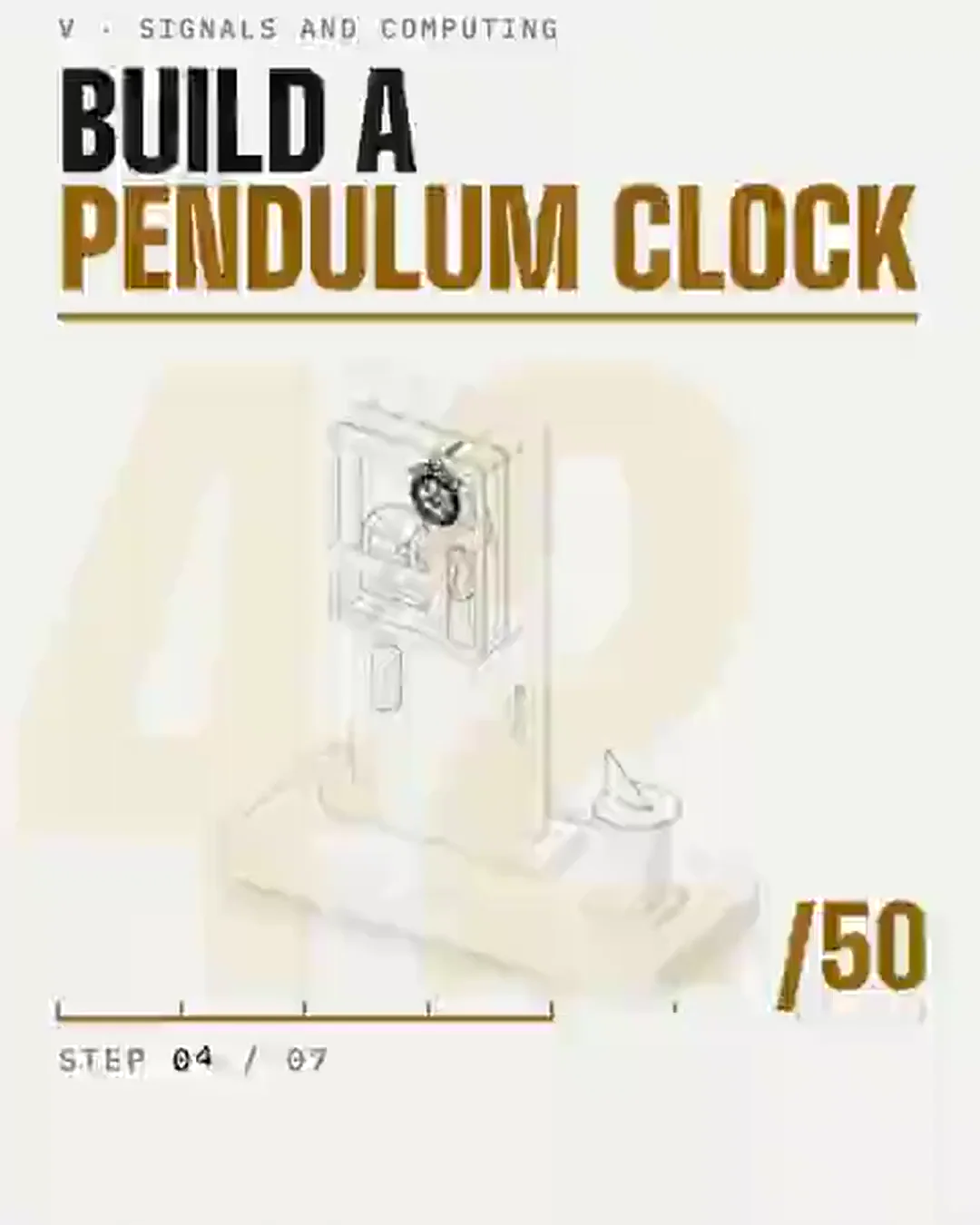
The escapement: anchor, escape wheel and each beatParts already in placeA seconds pendulum swings once each way in a second, so its period is T = 2 s, and from T = 2π√(L/g) its length is g·T²/4π² = 994.0 mm, measured here from the spring's bend to the middle of the bob. The anchor lets the 30-tooth escape wheel move half a tooth at every beat, so it turns once a minute; 64/8 × 60/8 = 60 turns of it make one turn of the centre arbor, which carries the minute hand, and the 36/12 × 40/10 motion work slows that 12 times for the hour hand. The 96-tooth great wheel turns once in 12 hours; its 5 cm barrel pays out 31.4 cm of cord a day, and the pulley halves that to 15.7 cm of fall, about 2.2 days a winding. Because T grows as √L, a pendulum 1 mm too long beats 43.5 s a day slow (dT/T = dL/2L = 1/1,988). The model swings ±2.5°, ignores friction, air and the bob's own size, and rates nothing but length; a steel rod would also drift about 0.5 s a day for each °C. With a pendulum, clocks went from about 15 minutes a day to about 15 seconds; Huygens' first, in 1656, kept under a minute a day and later about 10 s. Drawn at 1 cm to the unit, finer than the 2.5 cm of the plant guides, and the wheels are cut large so the train can be read. This is a guide to how the parts go together, not engineering drawings. Keep fingers clear of the train while the weight is on, and let the weight down slowly: a falling weight breaks feet and cords.