Machine 14Build a line shaft workshop← → step through the guideshell · 8.25 × 2.2 m
Shaft0 rpm
Latheidle
Grindstoneidle
Drill pressidle
Fan0 rpm
Power0 W
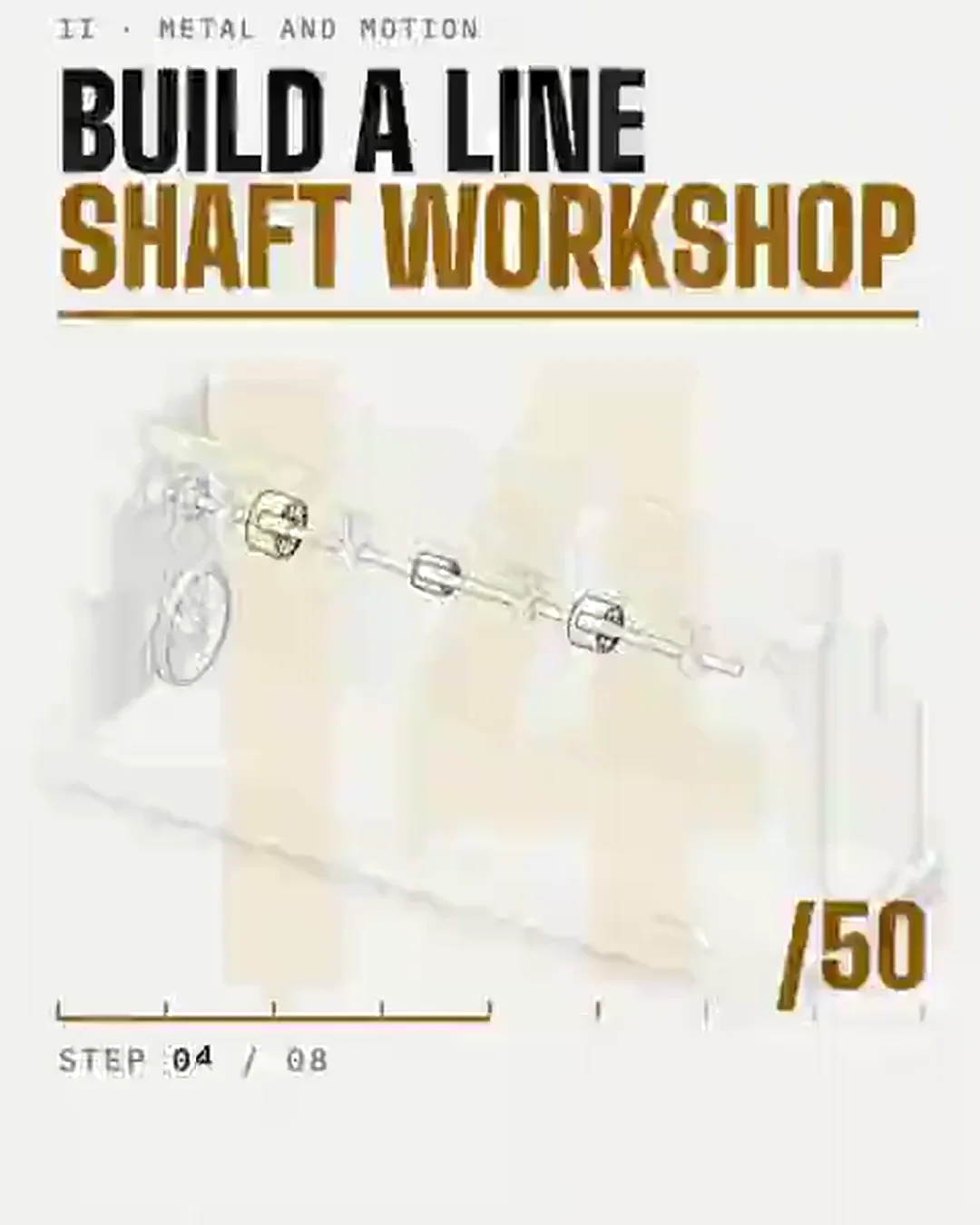
What this step adds; in part B, belts carrying powerParts already in placeOne power source runs the whole shop. A stub of the water-wheel shaft turns 60 rpm, and its 1.2 m pulley belts a 40 cm pulley on the line shaft: 180 rpm. Every drop follows n₂ = n₁ · D₁ / D₂. A 60 cm drum on the 20 cm lathe pulley gives 540 rpm. 35 cm on the grindstone's 45 cm gives 140 rpm, 4.4 m/s at the rim of a 60 cm stone. 50 cm on the drill's 20 cm gives 450 rpm. 32 : 16 bevel gears turn the fan at 360 rpm. The power figures are assumptions, not measurements. The stub gives 1.5 kW and holds its speed. Each belt passes on 95% and the bevel pair 90%. Five bearings lose 15 W each, and the machines take 400, 300 and 250 W when cutting. With everything running that adds up to about 1.2 kW. Belt slip is ignored, and the drawing turns at a sixth of true speed. This is a guide to how the parts go together, not engineering drawings. Unguarded belts and pulleys catch clothing and hair: guard every drop (the guards are left off the drawing so the belts show), and never shift a belt by hand while it runs.