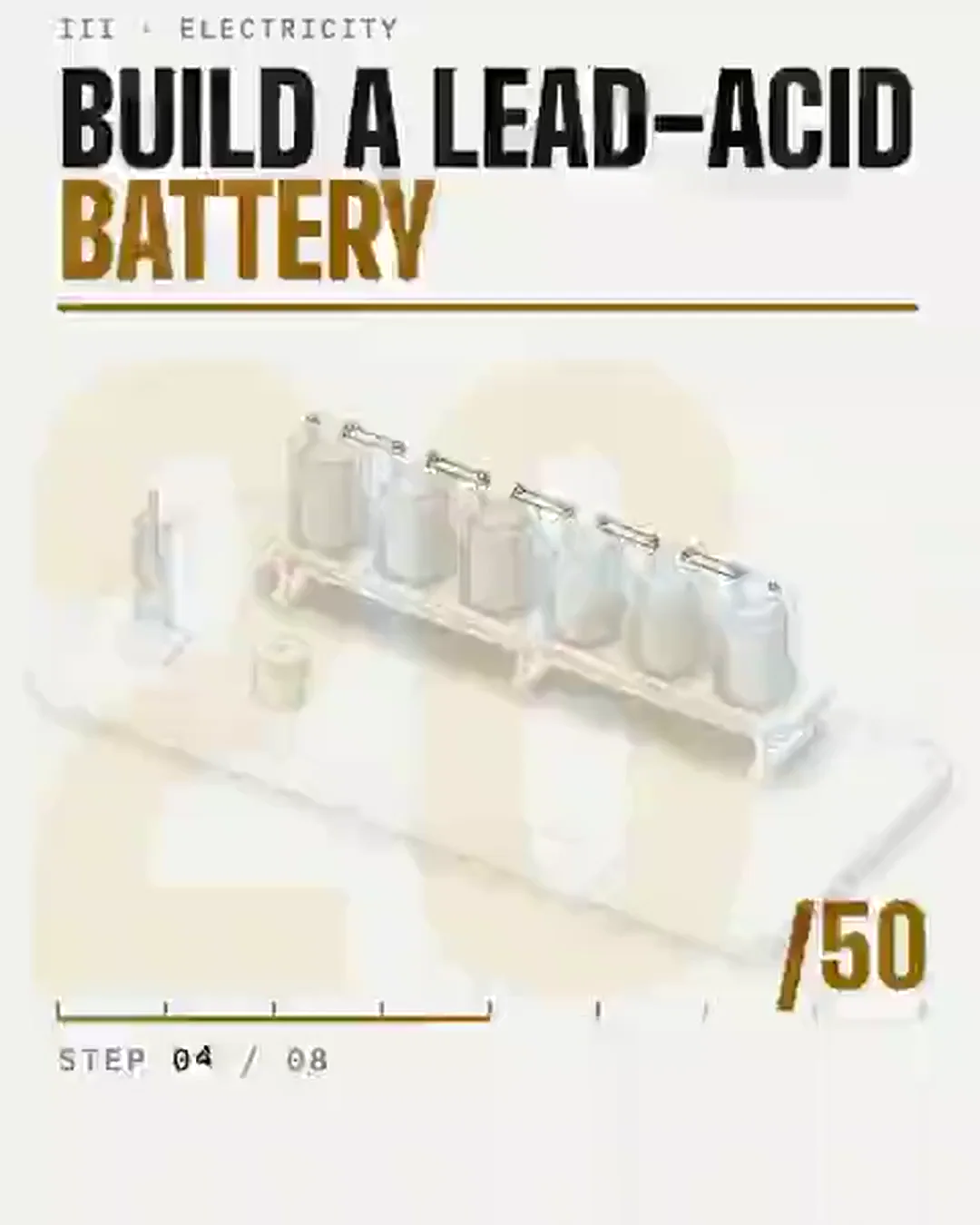
Machine 26Build a lead-acid battery← → step through the guiderack · 1 m shelf · 11 cm up
Per cell0.00 V
Bank0.0 V
Current0.00 A
Formed0 Ah
Charge0%
Acid1.068
What this step adds; in part B, the current and the lampParts already in placeA Planté cell is two lead sheets rolled together with separator strips between them, standing in about 10% sulfuric acid (specific gravity 1.068). Forming reverses the charging current again and again; each reversal turns a little more of each sheet's surface into active material, lead dioxide on the plate that ends positive and spongy lead on the other, and only that layer stores charge. Six cells in series make a nominal 12 V bank. The model is simple and stated: a cell at rest gives about 0.84 + specific gravity volts, so 1.91 V at this acid; the acid weakens as the plates take up sulfate (3.66 g of acid per Ah), from 1.068 full to 1.055 at the cut-off. Charging at a steady 1.25 A follows a typical lead-acid shape, not a measured Planté curve: it climbs to 2.35 V a cell, where the cells gas freely, at about 90% charge. The 12 V 10 W lamp then runs about 12 hours before the bank reaches 1.75 V a cell (10.5 V). The notes give no capacity for a Planté cell, so the model assumes 10 Ah once formed and 0.02 Ω inside each cell; the number of reversals in the run is illustrative and sped up. The notes say the 1859 separators were rubber strips, or linen in another account: the source is uncertain. Drawn at 1 unit = 5 mm, with fewer turns of sheet than a real 1 m roll, and from a little higher than the other guides (36°) to see into the jars. This is a guide to how the parts go together, not engineering drawings. Sulfuric acid burns skin and blinds: wear goggles, gloves and an apron, keep baking soda and water at hand, and always add acid slowly to water, never water to acid. Charging gives off hydrogen: no flames or sparks near the cells, and ventilate the room.