Machine 01Build a pottery and brick kiln← → step through the guidefooting · 2.0 × 1.8 m
Firing0.0 h
Chamber20 °C
Glownone
Cones down0 of 4
Phasecold
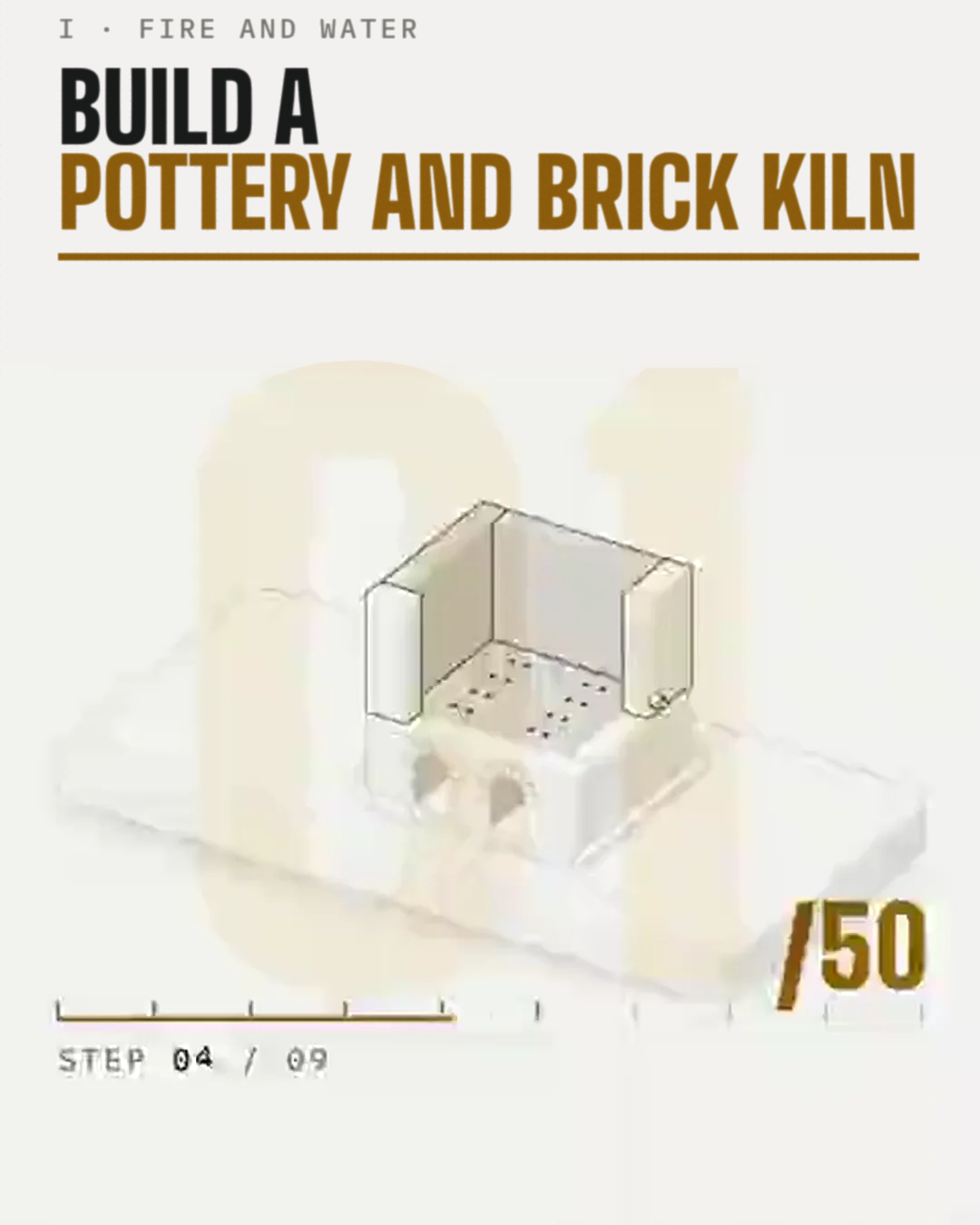
What this step adds; in part B, the heat and the conesParts already in placeAn updraft kiln 1.8 × 1.6 m, in 215 × 102.5 × 65 mm bricks. Fire in two tunnels under a perforated floor; the hot gas rises through the setting and leaves by the chimney. Bricks fire at 900–1,000 °C and earthenware at 1,000–1,200 °C, so this firing tops out at 1,000 °C. The schedule is the model's assumption: 6 hours of slow water-smoking to 200 °C, a climb of 100 °C an hour, a one-hour soak, then natural cooling with every opening shut, below 100 °C after about 35 hours. The four cones are chosen to bend at 900, 950, 1,000, 1,050 °C; the model bends each one from the hottest moment so far, starting 30 °C below its rating, though real cones answer to time as well as temperature. Glow starts near 525 °C; its colours are the usual eye estimates. This is a guide to how the parts go together, not engineering drawings. A kiln at 1,000 °C burns on contact and its stoke holes throw flame: build it outdoors, well clear of buildings and anything that burns, wear leather gloves and eye protection at the stoke holes and spy hole, and never open it hot.