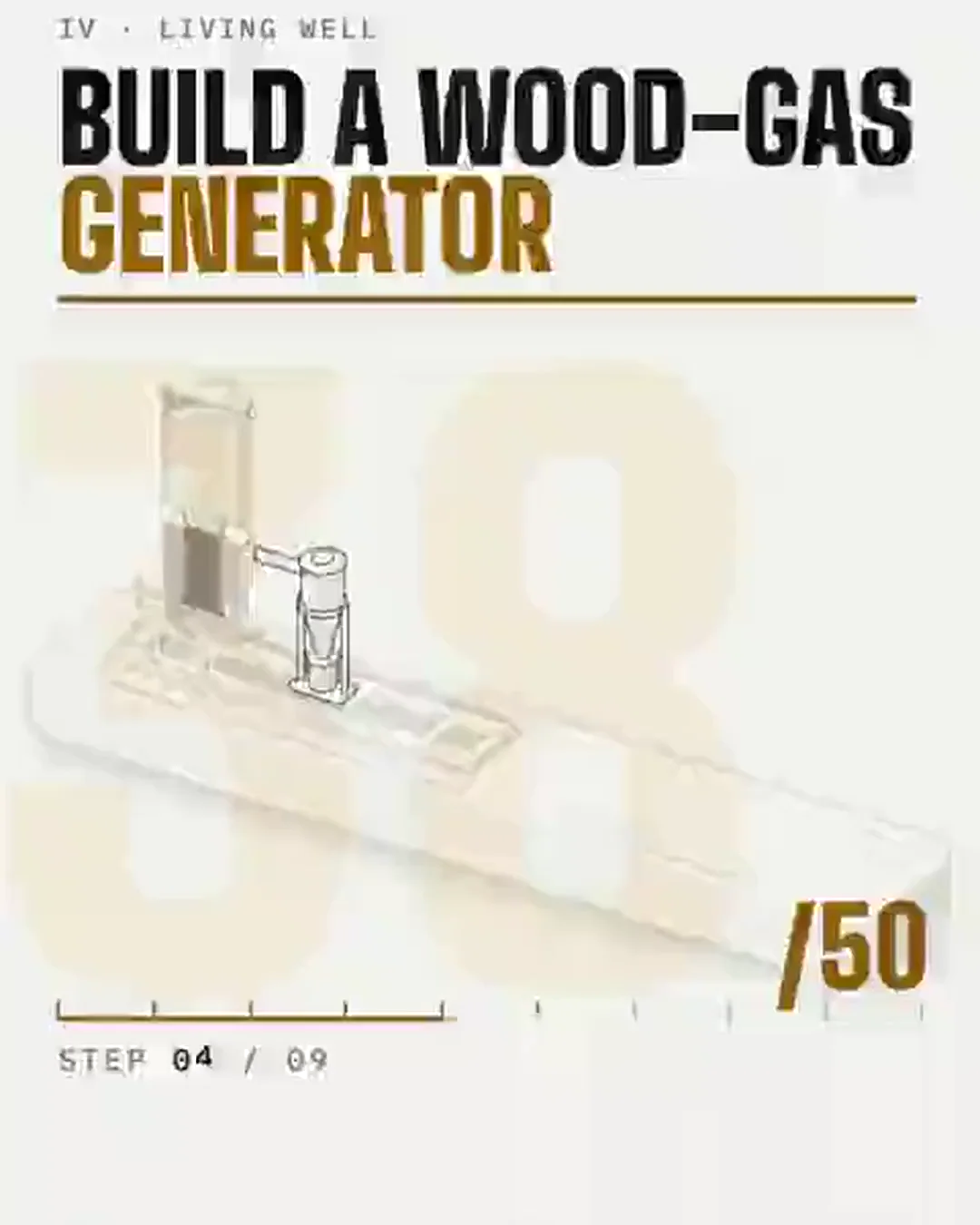
Machine 38Build a wood-gas generator← → step through the guideskid · 2.3 m × 35 cm
Wood0.0 kg/h
Gas0.0 m³/h
Gas power0.0 kW
Engine0 rpm
Output0 W
What this step adds; in part B, the fire, the gas and the powerParts already in placeA stratified downdraft gasifier after the FEMA/ORNL emergency design (ORNL-6404, 1989): a 0.5 m steel-drum hopper over a 24 cm fire tube with 16 air holes, a shaking grate, a cyclone and a filter barrel, feeding a salvaged 4.1 kW (5.5 hp) single-cylinder engine on a 230 V generator; the gasifier stands 1.63 m tall. The yields are the model's assumptions, not the manual's figures: 2.2 m³ of gas per kg of air-dry chips at 5 MJ/m³, an engine that turns 25% of the gas's energy into shaft work and burns 1.5 kW of gas just to keep turning, 85% in the generator, and about 2 kW available on wood gas, half its petrol rating. Gas power is flow × heating value; at 1,200 W of lamps the engine draws 7.1 kW of gas, 5.1 m³/h from 2.3 kg of chips an hour, about 1.9 kg of wood per kWh. A two-pole generator at 3,000 rpm gives 50 Hz. The hand blower is assumed to draw 3 m³/h while lighting. Drawn at 2.5 cm to the unit; the coupling turns slower than life. This is a guide to how the parts go together, not engineering drawings: build from the ORNL-6404 manual itself. Producer gas is poison: its main fuel is carbon monoxide, which you cannot see or smell and which kills in an enclosed space. Run it outdoors only, never in a building or a garage, and never stand downwind of the flare or the exhaust. Every joint must be airtight, so leaks are found with soapy water before lighting. The fire tube, hopper and pipes run hot enough to burn and to start fires: keep a clear, non-burning ground round it and an extinguisher at hand.